
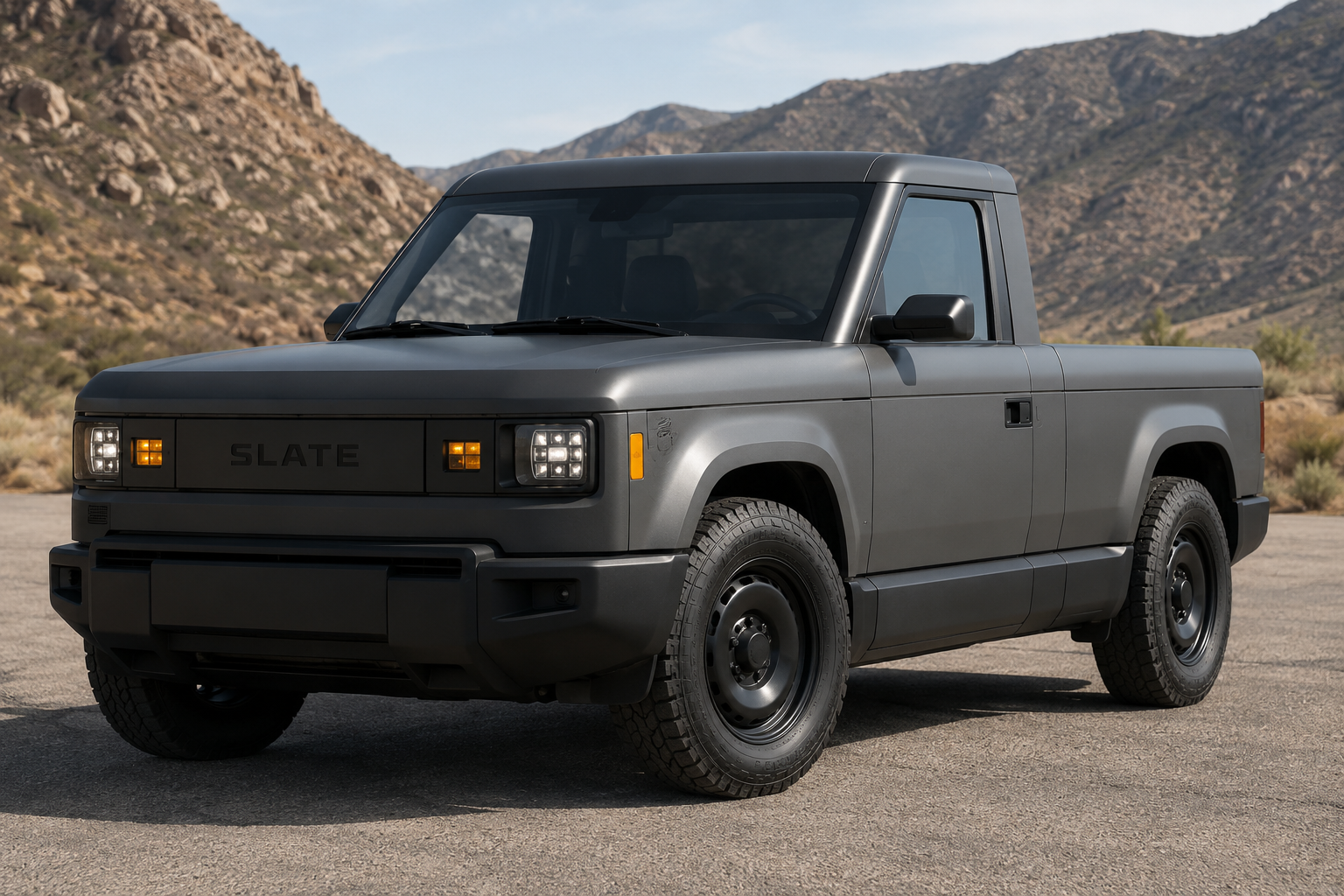
Slate truck is one of the most interesting new electric vehicle ideas in the American automotive market. Instead of trying to be the biggest, fastest, or most luxurious pickup, the Slate truck takes a different road. It focuses on simplicity, affordability, customization, and everyday usefulness.
The basic idea is easy to understand. Buy a simple electric pickup and add the features you actually want. A driver can keep it as a compact work truck, personalize it with accessories, change its appearance with wraps, or even convert it into an SUV-style vehicle. That’s a pretty unusual approach in a market where buyers are often pushed toward expensive trim packages.
According to Slate’s current official information, the Blank Slate starts at $24,950, offers a projected range of 205 miles, and is available for preorder in the United States. The company says the vehicle is still in preproduction, so final specifications, timing, and features may change before customer deliveries.
So, what makes the slate truck special? Is its low starting price enough to attract buyers? Who is it designed for? And what should potential customers know before placing a preorder?
Let’s take a close look.
What Is the Slate Truck?
The Slate truck is a compact electric pickup created by Slate, a new American vehicle company. The vehicle has been designed around a simple idea: not every customer needs a fully loaded truck with countless expensive features.
The basic version, called the Blank Slate, starts with the essential equipment. From there, the owner can add accessories and change the vehicle over time. Slate describes the truck as a highly customizable platform that can adapt as the owner’s needs change.
This means someone could use the vehicle as a simple pickup today and later add equipment or a conversion kit to create a different type of vehicle. The company offers configurations that include a five-seat SUV and a fastback-style option. In other words, the Slate truck isn’t meant to have only one permanent identity. It can change with its owner.
That’s the heart of the Slate idea. Instead of saying, “Choose everything now and live with it forever,” the company is saying, “Start simple and build from there.”
Slate Truck at a Glance
| Feature | Current Slate Information |
|---|---|
| Vehicle type | Electric pickup truck |
| Starting price | $24,950 |
| Drive system | Single-motor, rear-wheel drive |
| Projected standard range | 205 miles |
| Seating in basic truck | Two seats |
| Other body options | SUV and Fastback configurations |
| Customization | More than 200 accessories |
| Exterior personalization | Wraps and decals |
| Charging standard | NACS |
| Sales model | Direct to consumer |
| Availability | United States |
| Preorder deposit | $300 non-refundable |
| Delivery timing | Expected from late 2026, with later windows depending on preorder timing |
The information above reflects Slate’s current published details. Prices generally exclude taxes, registration, government fees, optional equipment, and the destination charge, while specifications remain subject to change because the vehicle is still in preproduction.
Why the Slate Truck Is Different
The modern vehicle market can be complicated. A buyer may have to choose between several trims, option packages, technology packages, appearance packages, premium wheels, luxury interiors, and dealer-installed extras.
The Slate truck takes a more direct approach.
The basic vehicle starts as simply as possible. Slate then gives customers the opportunity to add what they want. The company currently promotes more than 200 accessories and says many are designed to be added over time rather than forcing buyers to pay for everything at the beginning.
This approach could be especially useful for people who don’t want to spend a large amount of money on features they may never use.
For example, a person might initially need:
- A small electric pickup for commuting
- Basic cargo space
- Simple controls
- Affordable ownership costs
Later, that same person might need:
- More passenger space
- Additional storage
- A roof rack
- New lighting
- Audio equipment
- A different exterior appearance
- SUV-style body conversion
The Slate truck is designed around the idea that these needs can change. Well, life changes, doesn’t it? A vehicle that can adapt may appeal to people who want to keep one vehicle for a longer period.
Slate Truck Price and Affordability
Price is one of the biggest reasons people are talking about the Slate truck.
Slate currently lists the Blank Slate at a starting price of $24,950. The company markets it as the most affordable new pickup truck in America based on its cited market comparison. However, buyers should carefully understand what the starting price includes and what it doesn’t.
The published starting price does not include certain additional costs, such as:
- Taxes
- Title and registration costs
- Government fees
- Documentation fees
- Optional accessories
- A destination charge currently listed at $1,450
This means the final out-the-door cost can be higher than the advertised starting price. That’s true for many vehicles, of course, but it’s important not to confuse the base MSRP with the complete purchase cost.
Still, the base price is significant. Electric trucks have often been associated with much higher prices. Slate’s strategy is to offer a smaller and simpler vehicle rather than competing directly with expensive full-size electric pickups.
The affordability story also goes beyond the purchase price. Electric vehicles can potentially reduce some operating expenses because they do not require gasoline and generally have fewer traditional engine-related components. Actual savings, naturally, depend on electricity prices, driving habits, insurance, repairs, and other personal factors.
Slate Truck Range and Battery Performance
Range is one of the most important questions for any electric vehicle buyer.
Slate currently says the Slate truck has a projected range of 205 miles with its standard battery. The company previously discussed a lower estimated range, but later announced an increase while maintaining the same advertised starting price.
This range is intended mainly for everyday driving needs rather than long-distance travel without planning. For many drivers, 205 miles may be enough for commuting, shopping, school runs, local business travel, and regular daily activities.
However, real-world range can change depending on conditions such as:
- Outside temperature
- Driving speed
- Traffic
- Cargo weight
- Accessories
- Battery condition
- Road conditions
- Use of heating or air conditioning
The company notes that the current figure is projected and based on its testing and an approximation of the EPA test cycle rather than a final official EPA range estimate. Buyers should therefore wait for final certified information before making a purchase decision based only on range.
For local and suburban drivers, though, the current projected range could be quite practical. Someone who travels moderate distances each day may be able to charge at home and rarely visit a public charging station.
Charging the Slate Truck
The Slate truck is designed with the North American Charging Standard, commonly known as NACS.
According to Slate, owners will be able to charge using different methods, including a standard wall outlet, home charging equipment, and compatible public fast chargers. The company also says Slate customers will have access to Tesla Superchargers through the applicable charging network arrangement.
Charging flexibility is important because every owner has a different routine.
A driver with access to home charging may simply plug in while the vehicle is parked overnight. A person traveling farther may use public charging stations. The best charging method depends on the driver’s schedule and available infrastructure.
Before buying any electric vehicle, it is wise to consider:
- Whether home charging is available
- The cost of installing charging equipment
- Nearby public chargers
- Charging speed
- Daily driving distance
- Long-distance travel habits
The good news is that charging infrastructure continues to grow. Still, buyers should check their own area rather than assuming every route will have convenient charging.
The Simple Interior of the Slate Truck
One of the boldest decisions behind the Slate truck is its simple interior.
Many modern vehicles have large touchscreens that control everything from climate settings to entertainment. Slate has chosen a more basic approach, emphasizing tactile controls rather than building the interior around a giant central screen.
The company also says the vehicle is designed around devices people already own.
This choice may surprise some buyers. After all, screens have become almost standard in new cars. However, Slate’s approach has some possible benefits.
Physical controls can be easier to use without taking attention away from the road. A simpler dashboard may also help reduce complexity. And, importantly for Slate’s overall business plan, fewer built-in luxury features can help control the base price.
Of course, this approach won’t be perfect for everyone. Drivers who want a large integrated infotainment screen and a premium luxury cabin may find the basic Slate too simple. But that’s part of the point. The truck isn’t trying to be everything to everyone.
It’s taking a “keep it simple” approach and allowing buyers to add what they value.
Slate Truck Customization and Accessories
Customization is arguably the biggest part of the Slate truck experience.
Slate currently promotes more than 200 accessories and multiple ways to personalize the vehicle. These accessories can change the appearance, usefulness, and overall purpose of the truck.
Possible personalization areas include:
- Exterior wraps
- Decals
- Lighting
- Audio equipment
- Storage solutions
- Roof accessories
- Interior features
- Cargo equipment
- Wheels and related upgrades
- SUV conversion components
The company also promotes the use of wraps rather than traditional factory paint as part of its personalization strategy. A wrap can allow an owner to change the appearance of the vehicle without permanently repainting it.
This could be particularly attractive to people who enjoy creating a unique look. One owner may choose a clean professional appearance, while another may prefer a bright color, graphic design, or outdoor adventure style.
Slate’s current starter packs also show how accessories can be combined into different themes and price levels. The key idea is flexibility: the basic truck can remain simple, while customers can add features gradually.
How the Slate Truck Can Become an SUV
Perhaps the most unusual feature of the Slate platform is its ability to change body styles.
The company says customers can choose the vehicle as a pickup or select a five-seat SUV configuration. Slate also says owners can later change between supported body styles using a conversion kit.
This creates a very different ownership idea.
Imagine buying a compact pickup when you need cargo space and only two seats. Later, your family grows or your transportation needs change. Instead of immediately replacing the entire vehicle, a conversion may allow the Slate to serve a new purpose.
The current Slate lineup includes a Squareback SUV concept with additional seating and a more enclosed rear section. The company also offers a Fastback configuration. These options are part of the vehicle’s broader modular design philosophy.
That said, buyers should carefully review the cost and availability of conversion kits. The low base price of the Blank Slate doesn’t mean every upgraded configuration will cost the same.
Slate Truck Size and Cargo Space
The Slate truck is smaller than many traditional American pickups.
According to Slate’s published information, the truck measures about 174.6 inches long and has a five-foot cargo bed. The company also lists a front trunk, often called a frunk, for additional storage.
This combination could be useful for everyday tasks.
The cargo bed may help owners carry:
- Building materials
- Garden equipment
- Boxes
- Large shopping items
- Sports gear
- Camping supplies
- Home improvement materials
Meanwhile, the front trunk gives owners another enclosed place for luggage, groceries, tools, and smaller items.
A compact size may also provide an advantage in crowded areas. Large pickups can be difficult to park and maneuver. A smaller electric truck may be easier to use as a daily vehicle.
For people who regularly tow heavy trailers or haul extremely large loads, however, the Slate may not be the right choice. Published preproduction specifications have indicated modest towing capability compared with larger pickup trucks. Buyers who need serious work-truck performance should carefully compare payload and towing ratings once final production specifications are available.
Slate Truck Safety Features
Safety is another important part of the discussion.
Slate says the vehicle is designed to achieve a five-star USNCAP crash rating. The company currently lists several planned or included safety-related features, including:
- Forward collision warning
- Automatic emergency braking
- Traction control
- Electronic stability control
- Driver and passenger airbags
- Side curtain airbags
- Seat side airbags
- Backup camera
- Pedestrian identification
- Automatic high beams
- Remote keyless entry
Because the vehicle remains in preproduction, buyers should confirm the final safety equipment and independent crash-test results when production vehicles become available. A manufacturer’s design target is not the same thing as a completed independent test result.
Still, the focus on essential active and passive safety features is encouraging. Affordable doesn’t have to mean ignoring safety, and consumers should expect clear safety information before making a final purchase.
Who Should Consider the Slate Truck?
The Slate truck could appeal to several types of buyers.
Budget-conscious vehicle shoppers
People looking for a new vehicle at a lower starting price may find the Slate attractive. The base model is designed to provide the essentials without automatically adding expensive luxury equipment.
First-time electric vehicle buyers
Someone interested in trying an EV without buying a large premium electric truck may appreciate the simpler design and more approachable price.
Small business owners
A compact electric pickup could potentially work for local deliveries, maintenance businesses, property services, and other daily tasks. Slate also promotes the platform for fleet use and business applications.
DIY-minded owners
Slate says it wants to make personalization and maintenance more approachable. Its planned Slate U resource is intended to provide tutorials and educational content for owners who want to understand and work on their vehicles.
Drivers who love customization
Some people don’t want their vehicle to look exactly like everyone else’s. Wraps, accessories, and modular options give these buyers more room for creativity.
People who prefer simplicity
Not everyone wants a massive touchscreen, complex menus, and dozens of electronic features. For some drivers, straightforward controls may actually be a major selling point.
Possible Limitations of the Slate Truck
A balanced review should consider the challenges as well as the advantages.
First, the vehicle is still in preproduction. Final specifications, availability, and features can change. This is probably the biggest factor potential buyers should remember.
Second, the starting price is only the beginning. Adding accessories, conversion kits, wraps, fees, taxes, and other costs can raise the total purchase price.
Third, a projected range of 205 miles may be excellent for some drivers but limited for others. People who frequently travel long distances should consider their charging options carefully.
Fourth, the simple interior may not appeal to buyers who expect luxury features.
Finally, Slate is a relatively new automotive company. Long-term reliability, resale value, service experience, and real-world ownership costs will become clearer only after production vehicles reach customers.
None of these points automatically makes the Slate truck a poor choice. They simply show why buyers should look beyond the headline price.
How to Preorder a Slate Truck
Slate currently sells directly to consumers rather than using the traditional dealership model.
According to the company’s current information, customers can place a preorder with a $300 non-refundable deposit, which counts toward the final purchase price. Delivery timing depends on the production schedule and the buyer’s place in line.
Slate’s current preorder page shows that available delivery windows can extend into 2027 for new preorders, while the company continues to describe first deliveries as beginning in the late-2026 period. Potential buyers should check the latest delivery estimate at the time they place an order.
Before preordering, a smart buyer should review:
- The current preorder agreement
- Whether the deposit is refundable
- Estimated delivery timing
- Final purchase terms
- Destination costs
- Taxes and registration costs
- Available incentives
- Accessory pricing
- Charging needs
- Final vehicle specifications
A preorder isn’t the same as receiving a finished vehicle immediately. Reading the terms carefully is always a good idea.
The Future of the Slate Truck
The Slate truck represents a broader idea about where affordable vehicles could be heading.
For many years, new vehicles have become more expensive and more complicated. Screens have grown larger, trim levels have multiplied, and features that were once optional have become part of increasingly expensive packages.
Slate is taking a different direction.
Its idea is to begin with a simpler product and let the owner decide what to add. That strategy could help make new vehicles more flexible and potentially more affordable.
The company also plans to assemble vehicles in Indiana, while describing design and engineering work across California and Michigan. Its published materials connect the vehicle project with domestic manufacturing and factory investment.
Whether the Slate truck becomes a major success will depend on several things:
- Final build quality
- Real-world reliability
- Customer service
- Production capacity
- Final pricing
- Delivery performance
- Safety results
- Charging convenience
- The cost and usefulness of accessories
Still, the concept itself has already created attention because it challenges the usual idea of what a new electric truck needs to be.
Frequently Asked Questions About the Slate Truck
Is the Slate truck fully electric?
Yes. The Slate truck is an electric vehicle and is designed with a single-motor rear-wheel-drive system. It uses the NACS charging standard.
How much does the Slate truck cost?
The current starting price for the Blank Slate is $24,950. Buyers should remember that taxes, government fees, optional accessories, and the listed destination charge are additional costs.
What is the range of the Slate truck?
Slate currently states a projected standard range of 205 miles. This is not yet presented as a final official EPA range figure, and actual driving range will vary.
Can the Slate truck become an SUV?
Yes. Slate promotes conversion options that can change the vehicle from a pickup into supported SUV-style configurations. Buyers can also choose different body styles during the purchase process.
Does the Slate truck have a large touchscreen?
The basic Slate approach focuses on simplicity and tactile controls rather than a giant built-in touchscreen. The company encourages owners to use the devices they already have.
When will the Slate truck be delivered?
Slate expects deliveries to begin from late 2026, but current preorder availability can extend into 2027. Delivery timing depends on production schedules and the customer’s preorder position.
Can buyers customize the Slate truck?
Yes. Slate currently advertises more than 200 accessories, along with wraps, decals, lighting, interior additions, storage equipment, and conversion options.
Final Thoughts on the Slate Truck
The slate truck is more than just another electric pickup. It represents a different way of thinking about vehicle ownership. Instead of filling the base model with every possible feature and charging a high price, Slate begins with a simpler electric truck and gives customers the freedom to build on it.
Its biggest strengths are clear: an advertised starting price of $24,950, a projected 205-mile range, a compact pickup design, extensive customization, and the unusual ability to adapt into different vehicle forms. At the same time, smart buyers should remember that the vehicle is still in preproduction, optional equipment can increase the final cost, and long-term real-world performance remains to be seen.
For buyers who want a huge luxury truck, the Slate may feel too basic. But for someone who values affordability, flexibility, simplicity, and the chance to make a vehicle truly personal, it could be a refreshing option. In a world where many new vehicles seem to be getting bigger, more expensive, and more complicated, the slate truck takes a simpler path—and that might be exactly why so many people are paying attention.
Never miss a headline follow All News Here for fresh news, updates & insights every day.