
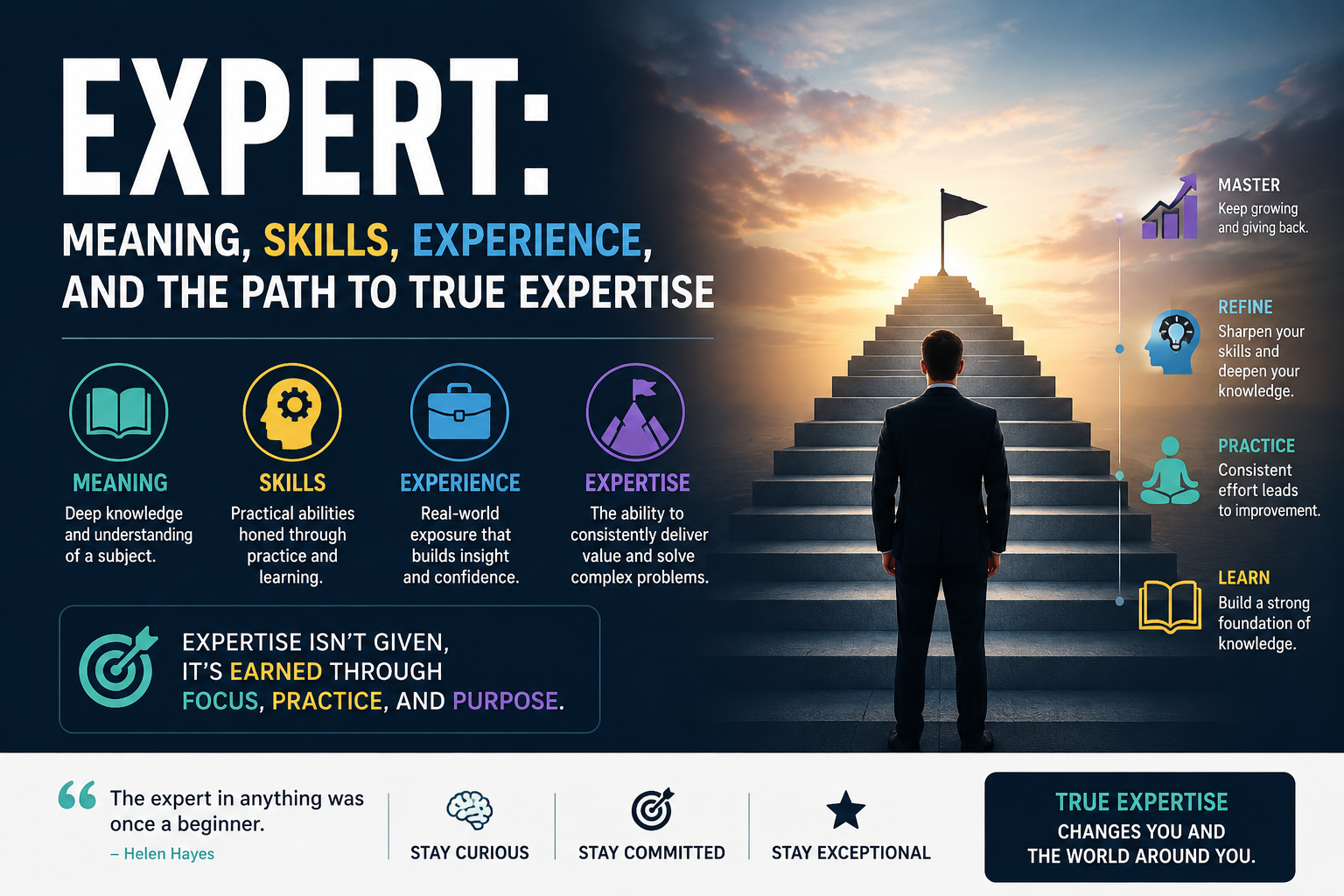
Expert is a powerful word that people often use to describe someone with deep knowledge, strong skills, and real experience in a particular field. An expert isn’t simply a person who knows a few facts. Instead, an expert understands a subject well, keeps learning, solves problems, and helps others with confidence and care.
In today’s fast-moving world, becoming an expert can open many doors. Businesses need experts to solve difficult problems. Students look for experts to guide them. Customers trust experts when making important decisions. From doctors and teachers to engineers, writers, chefs, marketers, and technology specialists, experts play an important role in almost every area of life.
However, here’s the interesting part: becoming an expert doesn’t happen overnight. Nobody wakes up one morning and magically knows everything. Real expertise usually grows through learning, practice, mistakes, patience, and experience. Little by little, a beginner can become skilled, and a skilled person can grow into a trusted expert.
This article explains what an expert really means, how expertise develops, why experience matters, and how anyone can build strong knowledge in their chosen field.
What Does Expert Mean?
An expert is a person who has a high level of knowledge, skill, or experience in a specific subject or activity. This person can understand difficult situations and make informed decisions based on what they have learned and practiced.
For example, a skilled mechanic may be an expert in finding problems in cars. A teacher may become an expert in explaining difficult subjects to students. A search engine optimization professional may become an expert in improving websites for search results. Each person has knowledge in a different area.
The word expert can also describe something done at a very high level. For instance, someone may give expert advice, perform an expert analysis, or provide expert service. In these situations, the word shows quality, knowledge, and skill.
Still, being an expert doesn’t mean knowing absolutely everything. That’s a common misunderstanding. Even the most experienced professionals continue learning. In fact, a true expert often understands how much there is still left to discover.
Why Becoming an Expert Matters
Becoming an expert can be valuable for both personal and professional growth. When people develop deep knowledge, they often become more confident in their work and more useful to others.
Expertise can also create new opportunities. Employers often look for people with proven skills. Clients may be willing to pay for professional knowledge. Businesses need specialists who can solve important problems. Therefore, strong expertise can lead to better career options.
Some important benefits of becoming an expert include:
- Greater confidence in your abilities
- Better problem-solving skills
- More career opportunities
- Increased trust from clients and employers
- Stronger decision-making ability
- The chance to teach and guide others
- Better earning potential
- A stronger professional reputation
Of course, expertise should not be used only for personal success. The best experts also think about how their knowledge can help other people. After all, knowledge becomes even more valuable when it is shared responsibly.
The Difference Between Knowledge and Expertise
Knowledge and expertise are closely connected, but they aren’t exactly the same thing. A person can read a great deal about a subject without having the ability to handle real-world situations.
Knowledge is what a person learns through reading, studying, watching, listening, and researching. Expertise goes further. It involves understanding how to use that knowledge effectively.
Imagine someone reading many books about cooking. That person may know a lot about ingredients and recipes. However, a chef who has prepared thousands of meals has practical experience. The chef understands timing, taste, texture, mistakes, and unexpected problems.
That’s why experience matters so much.
| Knowledge | Expertise |
|---|---|
| Learning information | Applying information successfully |
| Can come from books and courses | Develops through learning and practice |
| May be mostly theoretical | Usually includes practical experience |
| Helps a person understand ideas | Helps a person solve real problems |
| Can be gained quickly | Often takes time to develop |
A true expert usually combines knowledge with practice. They don’t just know what should happen. They understand what to do when things don’t go as planned.
How an Expert Develops Real Experience
Experience is one of the strongest building blocks of expertise. Every project, task, success, and mistake can teach something useful.
At first, learning may feel difficult. A beginner might need instructions for every step. Over time, repeated practice makes certain tasks easier. Eventually, the person begins to notice patterns and understand problems more quickly.
For example, a new website developer may take a long time to build a simple website. After completing many projects, the developer can work faster and recognize common issues. With enough practice, that person may become an expert who can solve complex problems.
Real experience teaches lessons that books sometimes can’t explain. A textbook may describe a problem, but actual work shows how that problem behaves in the real world.
Experience often comes from:
- Working on real projects
- Practicing skills regularly
- Learning from mistakes
- Receiving feedback
- Studying successful examples
- Facing new challenges
- Helping real clients or customers
- Reviewing past work
Sometimes people worry about making mistakes. Well, mistakes aren’t always the enemy. When handled wisely, a mistake can become a valuable lesson. The important thing is to learn from it instead of repeating it again and again.
Essential Skills of an Expert
An expert usually has more than technical knowledge. Strong professionals also develop useful personal and professional skills.
One important skill is critical thinking. An expert doesn’t accept every piece of information without question. Instead, they examine facts, consider evidence, and think carefully before reaching a conclusion.
Communication is also essential. Even the most knowledgeable person may struggle to help others if they can’t explain their ideas clearly. A true expert can often make a difficult subject easier to understand.
Here are several important skills that can support expertise:
Strong Problem-Solving
Experts are often trusted because they can deal with difficult situations. Instead of panicking when a problem appears, they look for possible causes and solutions.
Clear Communication
An expert should explain information in a simple and understandable way. Using complicated words doesn’t always prove intelligence. Sometimes, the ability to explain a difficult idea simply shows deeper understanding.
Curiosity
Curiosity keeps learning alive. Experts ask questions, explore new ideas, and look for better ways to do things.
Attention to Detail
Small details can sometimes create big problems. A skilled professional learns to notice important information that others may miss.
Adaptability
The world changes quickly. Technology, industries, and customer needs can change too. An expert must be willing to adapt and continue learning.
Patience
Real expertise takes time. There are no shortcuts that can replace meaningful learning and practice. As the old saying goes, slow and steady can win the race.
Expert Learning Never Truly Ends
One of the biggest signs of a genuine expert is a willingness to keep learning. A person who believes they already know everything may stop growing.
New research, technology, methods, and ideas appear all the time. What worked perfectly in the past may not always be the best solution today. Therefore, experts must stay informed.
Continuous learning can include:
- Reading books and trusted publications
- Taking professional courses
- Attending workshops
- Watching educational lessons
- Practicing new techniques
- Following changes in the industry
- Talking with experienced professionals
- Reviewing personal mistakes and successes
An expert understands that learning is a journey rather than a finish line. That’s what makes continuous improvement so important.
Even after reaching a high level of skill, there is always room to grow. A humble professional says, “I can still learn something new.” That attitude can lead to even greater expertise.
How Trust Helps Build an Expert Reputation
Knowledge alone doesn’t automatically make someone trustworthy. Reputation also matters.
People usually trust an expert who is honest, responsible, and clear about what they know. A trustworthy professional doesn’t make false promises simply to impress people.
For example, if a problem is outside an expert’s area of knowledge, honesty is better than pretending. Saying, “I don’t know, but I can research this further,” can actually build more trust than giving a confident but incorrect answer.
Trust can be built through:
- Giving honest information
- Avoiding false claims
- Respecting privacy
- Meeting professional commitments
- Admitting mistakes when necessary
- Using reliable information
- Treating people fairly
- Providing helpful guidance
Trust takes time to build but can disappear quickly. Therefore, experts should protect their reputation through consistent and responsible actions.
Expert Advice Should Be Based on Evidence
Good advice should not come only from personal opinions. Depending on the subject, an expert may need to use research, data, professional standards, testing, or real-world evidence.
For example, a business expert may study market data before giving advice. A technology professional may test a solution before recommending it. A financial professional should consider reliable information rather than guessing.
This doesn’t mean every situation has only one perfect answer. Some problems are complex, and different approaches may work. However, an expert should explain the reasons behind a recommendation.
Before giving expert advice, it is helpful to ask questions such as:
- What facts support this advice?
- Is the information current?
- Does the situation have special conditions?
- Are there possible risks?
- Is another solution better?
- What information is still unknown?
Careful thinking can make advice more useful and more trustworthy.
The Importance of Humility for an Expert
Humility might not sound like a technical skill, but it is extremely important. A person can be highly skilled and still benefit from listening to others.
A humble expert understands their strengths and limits. They don’t need to pretend to be perfect. They remain open to feedback and new ideas.
Interestingly, confidence and humility can work together. Confidence means trusting your abilities. Humility means understanding that you can still learn.
A strong professional might say, “Based on my experience, this is the best option I can see right now, but let’s examine the evidence.” This approach is confident without being arrogant.
Nobody likes a know-it-all who refuses to listen. On the other hand, people often respect a skilled person who remains polite and open-minded.
Common Myths About Becoming an Expert
There are many myths about expertise. These myths can discourage people who are still learning.
Experts Are Born, Not Made
Natural talent can be helpful, but practice and learning are also extremely important. Many successful professionals became skilled through years of effort.
An Expert Never Makes Mistakes
This isn’t true. Experts can make mistakes too. The difference is that experienced people often learn from errors and improve their methods.
You Need to Know Everything
No one knows everything. Most experts have deep knowledge in a specific area rather than every subject.
Expertise Happens Quickly
Real expertise usually takes time. Fast courses can introduce useful information, but deep understanding often requires continued practice.
Experts Don’t Need Help
Even highly experienced people sometimes ask for advice or work with other specialists. Collaboration can lead to better results.
Once these myths are removed, the path toward expertise becomes less frightening. Progress doesn’t require perfection. It requires steady learning and meaningful effort.
Building Your Own Expert Path
Anyone who is willing to learn and practice can work toward becoming an expert in a chosen area. The process may look different for each person, but some general steps can help.
First, choose a field that genuinely interests you. It is easier to continue learning when you care about the subject. Next, study the basics carefully. A strong foundation can make advanced learning easier later.
After that, practice in real situations. Reading is useful, but doing the work is where many important lessons appear. Start with simple projects and gradually take on more difficult challenges.
A practical path may look like this:
- Choose a specific field
- Learn the basic concepts
- Find reliable learning resources
- Practice regularly
- Complete real projects
- Ask for useful feedback
- Study mistakes carefully
- Improve weak areas
- Stay updated with changes
- Share useful knowledge responsibly
The journey may sometimes feel slow. You might think, “Am I really getting better?” That’s normal. Growth isn’t always easy to notice day by day. However, when you look back after months of focused effort, the difference can be surprising.
Expert Communication and Helping Others
A powerful way to strengthen expertise is by teaching others. Explaining a subject can reveal whether you truly understand it.
When teaching, an expert must organize information, answer questions, and simplify difficult ideas. This process can improve communication skills and deepen personal knowledge.
Helpful experts do not try to confuse people. Instead, they focus on making information clear.
Good communication often includes:
- Using simple language when possible
- Explaining important terms
- Giving practical examples
- Listening carefully to questions
- Avoiding unnecessary jargon
- Being respectful and patient
- Saying when more research is needed
Sometimes the best answer isn’t the longest answer. A clear and accurate explanation can be more valuable than a complicated speech.
Teaching can also create a positive cycle. The more people learn from an expert, the more questions they may ask. Those questions can encourage the expert to study and improve even further.
Expertise in the Modern Digital World
The internet has changed the way people learn and work. Today, someone can access educational videos, online courses, professional communities, research materials, and digital tools from almost anywhere.
This creates exciting opportunities. A person can learn skills that were once difficult to access. However, there is also a challenge: not everything online is accurate.
That’s why digital expertise requires careful thinking. An expert should check sources, compare information, and avoid sharing false claims.
In the online world, a strong reputation can grow through:
- Publishing useful and original content
- Showing real experience
- Providing accurate information
- Explaining methods clearly
- Updating outdated material
- Respecting readers and customers
- Being transparent about limitations
Simply calling yourself an expert is not enough. People usually look for proof through the quality of your work, your knowledge, your experience, and your results.
Actions speak louder than labels.
When Should Someone Call Themselves an Expert?
This question does not always have a simple answer. There is no single point where a person suddenly receives an invisible sign saying, “Congratulations, you are now an expert.”
In some professions, formal qualifications, licenses, or certifications may be important. In other fields, practical experience and a strong record of successful work may carry greater weight.
A person should be careful when using the title expert. It should reflect real knowledge and experience rather than being used only as a marketing tool.
Before using the word, consider:
- Do I have deep knowledge in this area?
- Have I applied my knowledge in real situations?
- Can I solve common problems?
- Can I explain the subject clearly?
- Do others recognize my work and experience?
- Do I continue learning and improving?
Being honest about your level of skill is always important. There is nothing wrong with being a learner, intermediate professional, specialist, or experienced practitioner. Every expert was once a beginner.
Challenges on the Road to Expertise
The journey toward expertise isn’t always smooth. People may face failure, criticism, confusion, or periods when progress feels very slow.
Sometimes a person compares themselves with someone who has many more years of experience. That comparison can feel discouraging. Instead of asking, “Why am I not as good as them?” it may be better to ask, “What can I learn from them?”
Another challenge is information overload. There are so many books, videos, courses, and opinions that choosing the right learning path can be difficult.
To manage these challenges:
- Focus on one important skill at a time
- Use reliable sources
- Avoid comparing your beginning with another person’s advanced stage
- Practice instead of only collecting information
- Accept useful criticism
- Take breaks when necessary
- Track your progress
- Keep long-term goals in mind
Progress may not always be dramatic. Sometimes expertise grows quietly through small improvements. One lesson, one project, and one solved problem can slowly build a strong foundation.
The Future of the Expert
The future will continue to create new forms of expertise. Technology is changing jobs, businesses, education, and communication. Some skills may become less important, while new specialties may appear.
However, the basic qualities of a strong expert will likely remain valuable. People will still need individuals who can think clearly, solve problems, understand complex situations, and act responsibly.
The experts of the future may need to work alongside advanced technology. They may need stronger digital skills, better communication, and a greater ability to adapt.
At the same time, human qualities will remain important. Creativity, judgment, empathy, responsibility, and ethical thinking cannot be ignored.
The future may change the tools, but the value of real expertise will remain.
A Simple Guide to Growing Every Day
Becoming highly skilled doesn’t require doing something dramatic every single day. Small, consistent actions can make a major difference over time.
Try building a regular learning routine. Read about your field, practice an important skill, review your work, and identify one area for improvement.
You can ask yourself:
- What did I learn today?
- What problem did I solve?
- What mistake taught me something useful?
- What skill needs more practice?
- What information should I verify?
- How can I help someone with what I know?
These simple questions encourage reflection. Reflection can turn ordinary experience into meaningful learning.
So, don’t wait for the perfect moment. Start with what you know and build from there. Bit by bit, your knowledge can become stronger, your skills can become sharper, and your confidence can grow.
Final Thoughts on Becoming an Expert
Becoming an expert is not about pretending to know everything or using a big title to impress others. True expertise is built through knowledge, experience, practice, curiosity, honesty, and continuous improvement.
The path may take time, and yes, there may be mistakes along the way. But that’s part of the journey. Every difficult project can teach something. Every useful lesson can make you stronger. Every challenge can help you understand your field more deeply.
A trusted expert combines skill with responsibility. They learn carefully, think critically, communicate clearly, and remain open to new knowledge. Most importantly, they use their abilities to solve problems and create value for others.
Whether your goal is to become an expert in business, technology, education, writing, marketing, design, science, or any other field, remember that progress begins with a willingness to learn. Keep practicing, stay curious, accept useful feedback, and don’t give up when the journey becomes difficult.
In the end, a real expert is not someone who claims perfection. A real expert is someone who keeps learning, applies knowledge wisely, earns trust through experience, and continues striving to become better.
Never miss a headline follow All News Here for fresh news, updates & insights every day.