
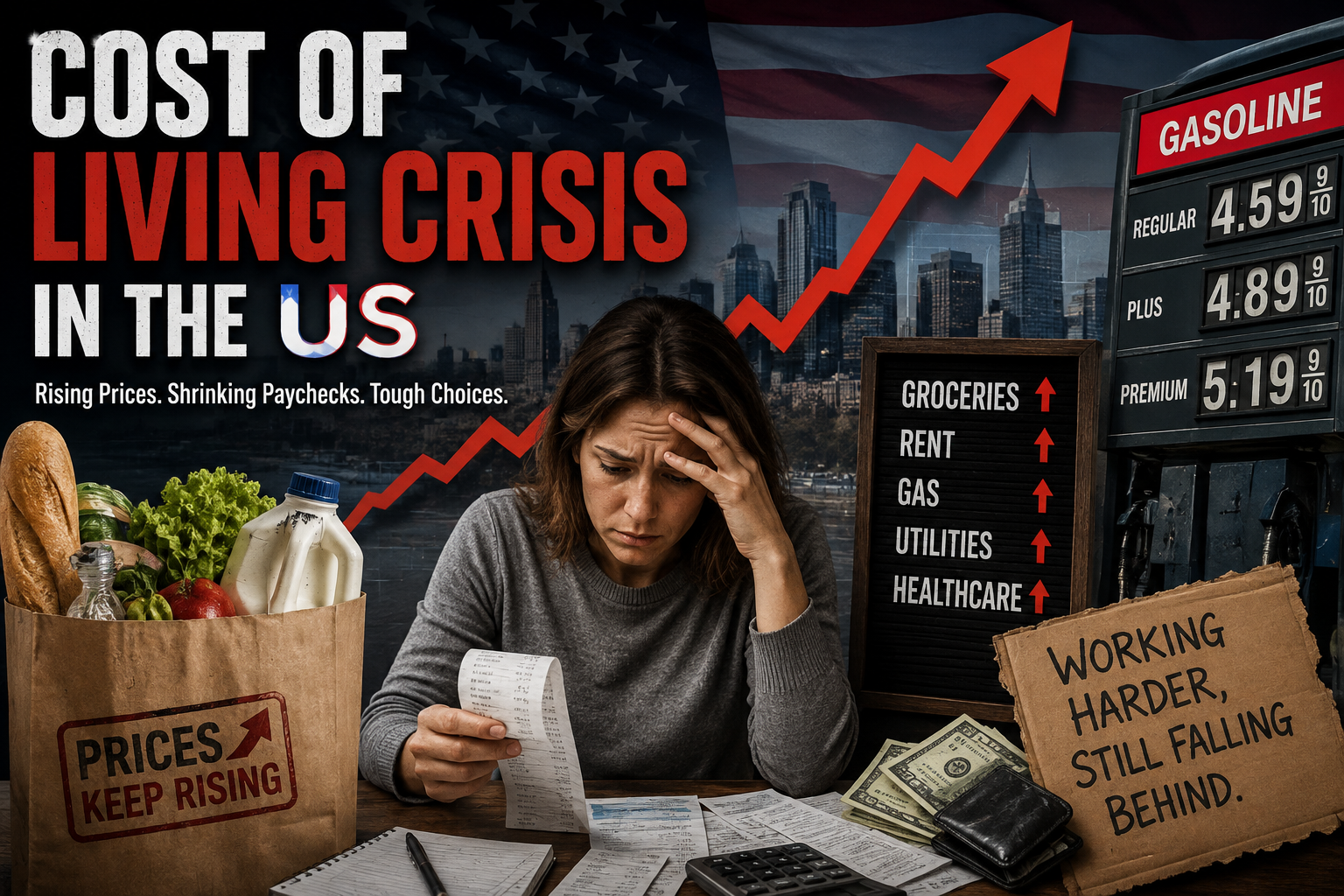
The cost of living crisis us has become an important economic issue for households across the United States. From groceries and housing to healthcare, transportation, utilities, and everyday services, many Americans feel that their regular income doesn’t stretch as far as it once did. Even when wages rise, higher prices can reduce the amount of money families have available for saving, emergencies, education, and leisure.
The situation isn’t the same for everyone. A family living in a large coastal city may face very different pressures from a household in a smaller Midwestern town. Likewise, renters, homeowners, retirees, students, and working parents experience rising costs in different ways. Still, the common concern is clear: cost of living crisis us discussions are increasingly focused on affordability and household financial security.
Understanding the causes of this situation is important. More importantly, knowing how families, businesses, and policymakers can respond offers a more useful and optimistic perspective. Although affordability remains a serious challenge, there are practical ways to improve financial stability and build stronger communities.
What Is the Cost of Living Crisis US?
The cost of living crisis us refers to a period when the prices of essential goods and services rise faster than many people’s incomes or ability to manage their household budgets. In simple terms, people may earn more money than before but still feel financially squeezed because their expenses have increased even more.
The phrase isn’t limited to one particular product or service. It can include several areas of household spending, such as:
- Housing and rent
- Groceries and food
- Electricity and natural gas
- Gasoline and transportation
- Health insurance and medical care
- Childcare and education
- Home repairs and maintenance
- Personal services
- Taxes and other household obligations
One important point is that inflation and the cost of living aren’t exactly the same thing. Inflation measures how prices change over time, while the cost of living reflects how much money people need to maintain a certain standard of life. When essential expenses remain high, households can continue feeling pressure even after the overall inflation rate starts to cool.
That’s why the cost of living crisis us isn’t simply about whether prices are rising quickly today. It’s also about the higher price level that households are already facing.
Why Has the Cost of Living Increased?
There isn’t one single reason behind the cost of living crisis us. Instead, several economic forces have affected household budgets at the same time.
The COVID-19 pandemic caused major disruptions to production, shipping, employment, and consumer behavior. As economies reopened, demand recovered quickly in many sectors. Supply chains, however, took time to adjust. These imbalances contributed to higher prices for many goods.
Energy prices have also influenced the cost of transportation, manufacturing, heating, and other activities. When fuel and energy become more expensive, businesses often face higher operating costs. Some of those costs can eventually appear in the prices consumers pay.
Housing is another major factor. In many communities, the supply of affordable homes hasn’t kept pace with demand. Higher mortgage rates can also make buying a home more difficult, while limited housing supply can place additional pressure on rents.
Labor markets have changed as well. Workers in many industries have received higher wages, which is positive for household income. Yet wage growth doesn’t always affect every worker equally, and higher earnings may still be outpaced by expenses in expensive areas.
In short, the cost of living crisis us is the result of interacting forces rather than one simple economic problem.
Housing and Rent Pressures
Housing is often one of the biggest parts of a household budget. For renters, rising monthly payments can quickly reduce the money available for food, transportation, savings, and other needs.
The challenge can be especially serious in areas where employment opportunities are strong but housing construction has not kept up with population growth. A limited number of available homes can push prices and rents higher.
Homeowners face a different set of challenges. Although homeowners with fixed-rate mortgages may have more predictable monthly payments, people who want to purchase a home can face high property prices, mortgage rates, insurance costs, and maintenance expenses.
Housing affordability also affects younger adults. Some may delay buying a home because saving for a down payment while paying rent is difficult. Others may choose to live with family members or share housing with roommates for longer.
However, housing markets aren’t identical across the country. Some communities remain considerably more affordable than major metropolitan areas. Remote and hybrid work have also changed where some people choose to live.
As a result, location plays a major role in the cost of living crisis us.
Grocery Bills and Food Prices
Food is another area where families can immediately notice changes in their budgets.
A grocery trip that once fit comfortably within a household’s weekly spending limit may now require more careful planning. Meat, dairy products, fresh produce, packaged foods, snacks, and household supplies can all contribute to a higher checkout bill.
Food prices are influenced by many factors, including:
- Farming and weather conditions
- Transportation costs
- Labor expenses
- Packaging
- Energy prices
- Supply and demand
- Processing and distribution costs
Families don’t necessarily respond by buying less food. Instead, many change what they purchase. Store brands may become more attractive, while expensive convenience foods may be purchased less often.
Meal planning can also help. Preparing several meals at home, comparing prices between stores, using seasonal produce, and reducing food waste are relatively simple steps that may lower household spending.
These choices won’t solve the broader cost of living crisis us, but they can give families more control over part of their monthly budget.
Healthcare and Insurance Costs
Healthcare is a particularly important part of the American affordability discussion.
Medical spending can include insurance premiums, deductibles, copayments, prescription medicines, dental care, vision services, and unexpected medical bills. Even households with insurance can sometimes face significant out-of-pocket expenses.
Healthcare costs also vary according to employment, insurance coverage, location, family size, age, and individual needs.
Because healthcare is difficult to avoid, increases in medical expenses can have a stronger effect than increases in optional purchases. A family can postpone buying a new television, for example, but it can’t always postpone necessary medical treatment.
For this reason, healthcare remains an important part of any serious discussion about the cost of living crisis us.
Understanding an insurance plan, checking whether providers are in-network, comparing available options, and using preventive care where appropriate can sometimes help households manage expenses.
Transportation Is Another Major Expense
Transportation is essential for millions of Americans. People need reliable ways to travel to work, school, medical appointments, stores, and other locations.
For drivers, the total cost isn’t limited to gasoline. A household vehicle also involves:
- Car payments
- Insurance
- Maintenance
- Repairs
- Registration
- Tires
- Parking
- Fuel
Gasoline prices can change frequently, making transportation budgets difficult to predict. Vehicle repair costs can also be stressful, particularly when an unexpected problem requires a large payment.
Public transportation can provide an alternative in communities with reliable bus, rail, or other transit systems. Carpooling, walking, cycling, and combining multiple errands into one trip can also reduce expenses.
Still, transportation choices depend heavily on location. Someone in a major city may have several alternatives to driving, while a rural household may have few practical options.
Wages and Household Income
The income side of the equation is just as important as the price side.
When wages increase, workers have more purchasing power. Yet the real benefit depends on how wage growth compares with household expenses. If rent, food, healthcare, and other essential costs rise substantially, a larger paycheck may not feel like a major improvement.
This is why economists often consider real wages, which account for changes in prices. A worker can receive a nominal pay increase while experiencing little improvement in actual purchasing power.
Income also differs widely among households. Some workers have strong bargaining power and access to higher-paying careers, while others work in sectors where wage growth is more limited.
Education, skills, experience, geographic location, industry, and job demand can all affect earning potential.
One hopeful point is that workers can sometimes improve their financial position through training, certifications, career changes, additional skills, or opportunities in growing industries. Businesses that invest in employees can benefit too because better skills can improve productivity.
How the Crisis Affects Different Generations
The cost of living crisis us doesn’t affect every generation in exactly the same way.
Younger adults may struggle with rent, student debt, saving for a home, and establishing careers. High housing costs can make it difficult to build savings even when someone has a stable job.
Families with children often face additional expenses. Childcare, school-related costs, food, transportation, healthcare, and activities can create a large combined financial burden.
Middle-aged households may be balancing mortgage payments, childcare, retirement contributions, and support for older relatives. This can create competing financial priorities.
Retirees can face another type of pressure. People living on relatively fixed incomes may find it difficult to adjust quickly when food, housing, utilities, and healthcare expenses rise.
These differences show why a single solution won’t work for everyone.
Regional Differences Across the United States
One of the most important things to understand about the cost of living crisis us is that America isn’t one uniform housing or consumer market.
Living costs can vary dramatically between metropolitan areas, suburbs, small towns, and rural communities. Housing is often the biggest source of regional differences.
A high-paying job in an expensive city may not provide the same lifestyle as a lower-paying job in a more affordable area. For example, someone earning a strong salary may still have limited disposable income if rent and other essential expenses consume a large share of their earnings.
On the other hand, lower-cost areas may offer cheaper housing but fewer employment opportunities.
Regional differences can also affect:
- Utility bills
- Transportation
- Property taxes
- Insurance
- Food prices
- Childcare
- Healthcare access
Therefore, national statistics are useful, but individual household experiences can be very different.
The Role of Inflation
Inflation is central to understanding the cost of living crisis us.
When inflation is high, prices generally rise across the economy. However, not every product becomes more expensive at the same speed. Some categories may experience large increases while others remain relatively stable.
There is also an important difference between the inflation rate and the price level. Imagine a product becomes much more expensive over several years and then its price begins increasing more slowly. The inflation rate may fall, but the product doesn’t necessarily return to its old price.
That’s one reason people can continue feeling financial pressure after inflation has cooled.
For households, the practical question isn’t only, “Are prices still rising?” It’s also, “How much do today’s prices affect my monthly budget?”
How Families Are Responding
American households have developed many strategies to cope with higher expenses.
Some are cutting unnecessary subscriptions or entertainment spending. Others are changing grocery brands, refinancing when appropriate, moving to smaller homes, taking on extra work, or delaying major purchases.
Common household responses include:
- Creating a detailed monthly budget
- Comparing insurance policies
- Reducing high-interest debt
- Building an emergency fund
- Cooking more meals at home
- Shopping during sales
- Using public transportation when practical
- Looking for better-paying employment
- Developing new job skills
- Reviewing recurring subscriptions
These steps aren’t equally useful for everyone. A family already operating on a very tight budget may have little discretionary spending left to cut.
That distinction matters. Personal budgeting is valuable, but the broader cost of living crisis us also requires structural solutions involving housing, wages, healthcare, competition, infrastructure, and public policy.
What Can Policymakers Do?
Government policy can influence many of the factors that shape household affordability.
Housing policy is one important area. Encouraging responsible construction and increasing the supply of homes can help communities respond to demand. Policies can also support affordable housing development where appropriate.
Education and workforce programs may help people gain skills that lead to stronger employment opportunities. Supporting workers as industries change can improve long-term economic resilience.
Healthcare policy can also affect household budgets by influencing insurance access, prescription costs, medical pricing, and competition.
Infrastructure investments may reduce transportation burdens and improve access to employment.
At the same time, policymakers need to consider unintended consequences. A policy designed to help households can sometimes create new costs or reduce supply if poorly designed.
The best approach usually combines affordability support with policies that encourage productivity, investment, competition, and economic growth.
How Businesses Can Help
Businesses are also part of the solution.
Employers can help workers manage financial pressure by offering competitive wages, predictable schedules, useful benefits, flexible work arrangements where possible, and opportunities for advancement.
Businesses can also look for ways to improve productivity rather than simply passing every higher cost to consumers.
Competition matters, too. When companies compete on price, quality, service, and innovation, consumers can benefit.
For employees, professional development can create another path toward financial security. Learning new technical, digital, communication, or management skills may improve career opportunities over time.
In a difficult economic environment, cooperation between employers and employees can make a meaningful difference.
Practical Ways to Manage a Household Budget
Although nobody can control every economic factor, households can control some decisions.
Start by identifying essential monthly expenses. Housing, food, utilities, transportation, insurance, and debt payments should be separated from optional spending.
A simple household budget might look like this:
| Spending Area | What to Review |
|---|---|
| Housing | Rent, mortgage, insurance, maintenance |
| Food | Groceries, dining out, food waste |
| Transportation | Fuel, payments, insurance, repairs |
| Healthcare | Premiums, prescriptions, medical expenses |
| Utilities | Electricity, water, gas, internet |
| Debt | Credit cards, loans, interest rates |
| Savings | Emergency fund and long-term goals |
| Entertainment | Streaming, dining, hobbies and outings |
After identifying expenses, look for recurring costs that provide little value. Small monthly savings can become meaningful over a full year.
It’s also wise to avoid relying heavily on high-interest debt for everyday expenses. Credit can provide flexibility, but interest charges can make an already difficult budget even harder to manage.
Building an Emergency Fund
An emergency fund can provide an important layer of protection during uncertain economic times.
Unexpected expenses are almost unavoidable. A car repair, temporary job loss, home problem, or urgent family expense can quickly disrupt a household budget.
Even a small savings balance can provide some breathing room. The goal doesn’t have to be achieved immediately. Regular contributions, even modest ones, can gradually build financial resilience.
Once basic emergency savings are established, households can consider longer-term goals such as retirement, education, homeownership, or other priorities.
The key is consistency rather than perfection.
Debt Management During a Cost Crisis
Debt can become especially difficult when everyday expenses are already high.
High-interest credit card balances are particularly important to monitor because interest can accumulate quickly. Households may benefit from reviewing interest rates, prioritizing expensive debt, and avoiding unnecessary borrowing.
Some people may consider consolidation or refinancing, but these options should be evaluated carefully. A lower monthly payment doesn’t always mean a lower total cost.
Before taking financial action, consumers should understand fees, interest rates, repayment periods, and potential risks.
Financial decisions should be based on a person’s own circumstances rather than a one-size-fits-all recommendation.
The Psychological Side of Financial Pressure
Money problems aren’t only mathematical. Financial uncertainty can affect confidence, family relationships, work decisions, and overall quality of life.
People may feel frustrated when they work hard but still struggle to save. Others may compare their financial situation with friends or social media posts and assume they’re falling behind.
It’s important to remember that appearances don’t always show the full picture. Someone who appears financially comfortable may have significant debt or other obligations.
Healthy financial planning focuses on personal goals rather than constant comparison.
Talking openly with family members about priorities can also help. When everyone understands the household plan, it becomes easier to make decisions together.
Is the Cost of Living Crisis Permanent?
It would be incorrect to assume that current affordability pressures will remain unchanged forever.
Economies are constantly adjusting. Supply chains recover, businesses invest, workers change jobs, technology improves productivity, housing construction changes, and consumer behavior evolves.
Some prices may remain permanently higher than they were years ago, while other expenses may become more affordable over time.
Economic conditions also change from one period to another. Interest rates, employment, inflation, energy markets, housing supply, and government policy can all influence household finances.
Therefore, the cost of living crisis us should be viewed as a serious challenge, but not as proof that financial conditions can never improve.
Long-Term Solutions for a More Affordable America
Creating a more affordable economy requires long-term thinking.
Increasing housing supply can help address one of the biggest household expenses. Improving productivity can support stronger wages without creating unnecessary price pressure. Better infrastructure can reduce transportation costs and improve economic access.
Competition can encourage businesses to provide better value. Education and workforce development can help workers move toward careers with stronger earning potential.
Technology can also play a role. Automation, digital services, improved logistics, and new business models may reduce costs in some industries.
At the same time, economic growth should be broad enough that ordinary households can benefit from it.
A successful response to the cost of living crisis us isn’t simply about lowering one price. It’s about creating conditions where incomes, housing, services, and everyday necessities become more manageable for a wide range of people.
What Consumers Should Watch in the Coming Years
Consumers should pay attention to several economic indicators because they can influence household finances.
These include inflation, wage growth, mortgage rates, rent trends, employment, energy prices, and consumer spending.
However, headlines don’t always tell the full story. A falling inflation rate doesn’t mean that every price is falling. Similarly, strong employment numbers don’t guarantee that every household is financially comfortable.
People should focus on the expenses that matter most to their own budgets.
For example, someone renting may care most about local rent trends, while a homeowner may be more concerned about mortgage rates, property insurance, and maintenance costs.
This practical approach can make economic news easier to understand.
Final Thoughts on the Cost of Living Crisis US
The cost of living crisis us is a complex issue shaped by housing, food, healthcare, transportation, wages, inflation, energy, and regional differences. It affects households differently, but its central concern is simple: many people want their income to provide greater financial security and purchasing power.
There are no instant solutions. However, the situation isn’t hopeless. Families can strengthen their finances through careful planning, employers can support workers through better opportunities and benefits, and policymakers can pursue policies that improve housing supply, productivity, competition, infrastructure, and economic opportunity.
Most importantly, affordability should remain a long-term priority rather than a temporary political or economic talking point. With thoughtful decisions, responsible economic policies, innovation, and stronger opportunities for workers, the United States can move toward an economy where more households can meet their needs, build savings, and plan confidently for the future.
The cost of living crisis us is a serious challenge, but understanding its causes and pursuing practical solutions can help create a more stable and hopeful financial future.
Never miss a headline follow All News Here for fresh news, updates & insights every day.