
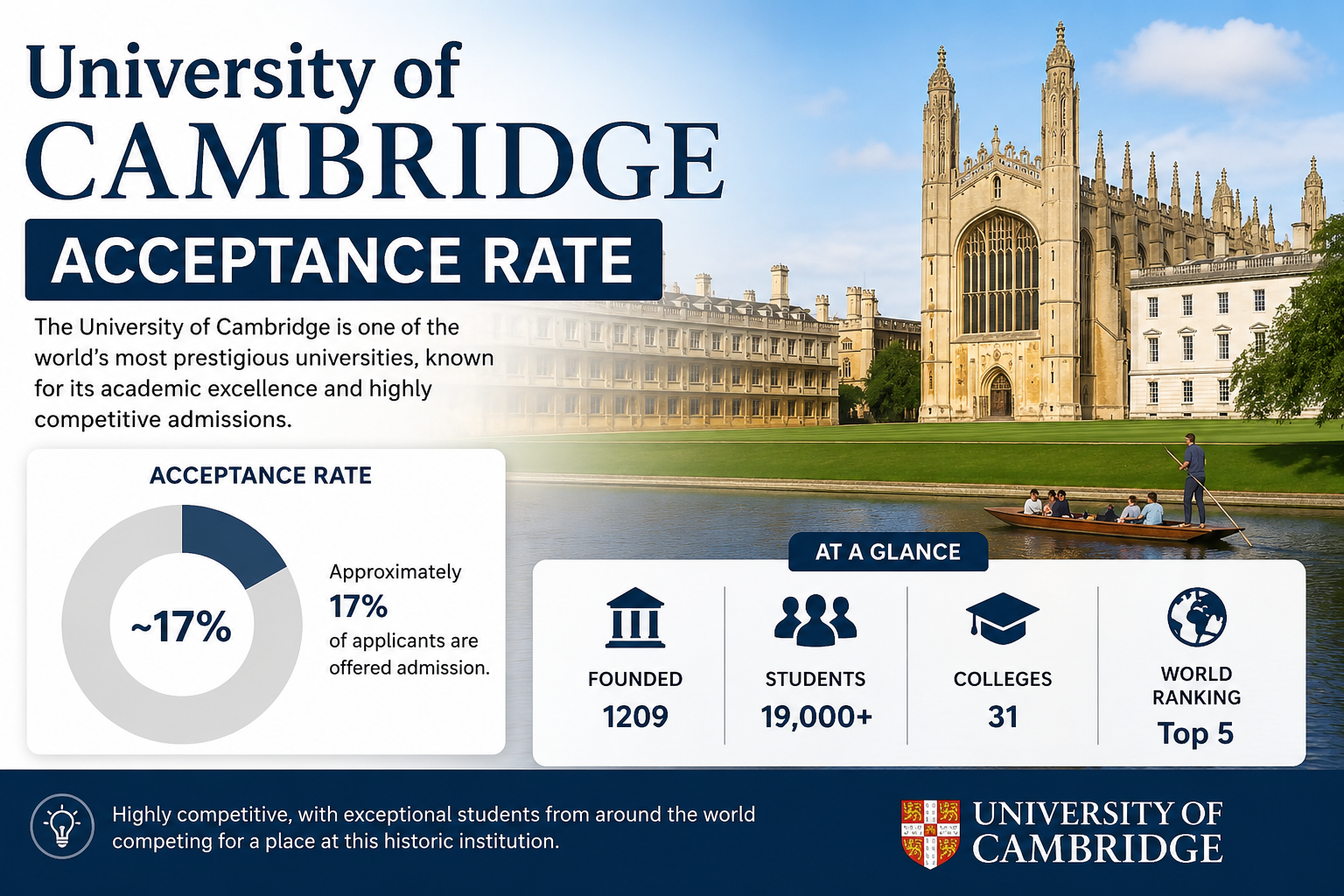
The university of cambridge acceptance rate is one of the most searched topics among students who dream of studying at one of the world’s most respected universities. Cambridge is famous for its academic standards, historic colleges, leading researchers, and highly competitive admissions process. Every year, thousands of talented students apply, but only a limited number can receive places.
According to the University of Cambridge, around six applications are received for every undergraduate place. In the 2025 admissions cycle, 22,513 people applied for around 4,890 undergraduate places. This works out to an overall acceptance rate of roughly 21.7%, although the exact rate can vary by course, applicant group, and admissions cycle.
It’s important to understand that the university of cambridge acceptance rate is not a simple pass-or-fail percentage. Cambridge uses a detailed selection process that considers academic ability, subject knowledge, potential, admissions assessments where applicable, interviews, and other parts of an applicant’s profile.
This guide explains the acceptance rate, recent statistics, course competition, international admissions, requirements, and practical ways applicants can improve their chances.
What Is the University of Cambridge Acceptance Rate?
The university of cambridge acceptance rate generally refers to the percentage of applicants who ultimately receive a place at Cambridge. For undergraduate admissions, the latest published university-wide figures show that Cambridge had 22,513 applications for around 4,890 places in the 2025 cycle. That means the broad acceptance rate is approximately 21.7%.
However, this figure shouldn’t be treated as a guaranteed probability for an individual applicant. Cambridge itself explains that it receives about six applications per place on average across subjects.
The reason is simple: not all courses have the same number of applicants or available places. Some subjects attract significantly more applications per place than others. Therefore, a student applying for one course may face a very different level of competition from someone applying for another.
| Cambridge admissions measure | Latest available figure |
|---|---|
| Undergraduate applications, 2025 | 22,513 |
| Approximate undergraduate places | 4,890 |
| Approximate overall acceptance rate | 21.7% |
| Average applications per place | About 6 |
| Undergraduate students, 2025–26 | 12,850 |
| Colleges | 31 |
The figures above show why the university of cambridge acceptance rate should be viewed as a broad indicator rather than a prediction of an applicant’s personal outcome. Cambridge publishes detailed admissions data so students can examine applications, offers, and acceptances by course and College.
University of Cambridge Acceptance Rate in Recent Admissions Cycles
Cambridge regularly updates its admissions information, making it possible to compare recent application cycles. The University’s official undergraduate statistics dashboard includes data going back many years, including applications, offers, and acceptances.
The 2025 cycle is especially useful for understanding the current level of competition. Cambridge reports 22,513 applicants competing for around 4,890 undergraduate places. This demonstrates that Cambridge remains highly selective, even though its overall acceptance rate is higher than the extremely low rates sometimes quoted online.
One important point is that an offer rate and an acceptance rate aren’t always the same thing. An offer means Cambridge has offered the applicant a place, often subject to conditions. An acceptance means the applicant has accepted or secured a place according to the relevant admissions definition.
This distinction matters when reading university statistics. Some websites use “acceptance rate” to describe offers, while others calculate the number of students who eventually enter the university. For accurate information, applicants should rely on Cambridge’s official statistics rather than random figures found on education blogs.
The University’s 2024 admissions statistics, for example, recorded 22,153 applications, 4,760 offers, and 3,632 acceptances, producing an overall success rate of 16.4% under the definition used in that report.
This also illustrates why the university of cambridge acceptance rate can appear different depending on the year and the exact statistical measure being used.
Why Does the Acceptance Rate Vary by Course?
One of the biggest mistakes students make is assuming that Cambridge has one fixed acceptance rate for every subject.
It doesn’t.
Cambridge is a collegiate university offering a wide range of subjects, and each course has its own applicant pool, number of available places, academic requirements, and competition level. As a result, the university of cambridge acceptance rate can differ considerably from one course to another.
For example, official Cambridge course information shows that the English course had three applications per place in the 2025 cycle, with 192 students accepted.
By comparison, Cambridge’s Faculty of English reports that its broader admissions information recorded 652 applications per place for a particular 2025 figure in its faculty fact file, showing how course-specific statistics can sometimes be presented differently depending on the population or measure being reported.
Another example is Education. Cambridge’s official course page reports five applications per place for Education in the 2025 cycle, with 34 students accepted.
This is why prospective students should research the exact course rather than focusing only on the university-wide percentage.
Factors That Can Affect Course Competition
Course competition may be influenced by:
- The popularity of the subject
- Number of available places
- Number and quality of applications
- Academic requirements
- Admissions assessments
- Interview performance
- College capacity
- Applicant background
- Changes in demand from year to year
Consequently, a course with fewer applicants isn’t automatically easier. A smaller applicant pool can still contain many exceptionally strong candidates.
University of Cambridge Acceptance Rate for International Students
International applicants often ask whether the university of cambridge acceptance rate is different for students from outside the United Kingdom.
The answer is more complicated than simply giving one percentage.
Cambridge welcomes students from around the world, but international applicants may have different qualifications, fee arrangements, visa requirements, and academic systems. Cambridge evaluates qualifications in the context of the applicant’s educational system.
The University’s 2024 statistics show that applicants classified as “Other applications” included substantial numbers from overseas. In that cycle, there were 7,638 applications in this category, 1,180 offers, and 851 acceptances, giving a reported success rate of 11.1%.
These figures should be interpreted carefully because the category includes different groups and is not identical to a simple “all international students” category.
For students applying from countries such as Pakistan, India, China, Singapore, Canada, the United States, and many others, the key lesson is that Cambridge does not expect everyone to follow the same school curriculum.
Instead, applicants should check Cambridge’s official country-specific requirements and make sure their qualifications are accepted for their intended course.
Does Cambridge Look Only at Grades?
Excellent grades are important, but Cambridge’s admissions process isn’t simply about having the highest marks.
The University states that it aims to admit students with strong academic ability and potential. Applications can be considered through several parts of the admissions process, depending on the course.
Academic preparation remains central because Cambridge courses are demanding. Students need to demonstrate that they’re prepared for advanced study and can engage deeply with their subject.
However, Cambridge also looks at evidence that an applicant has the potential to succeed in the academic environment.
Depending on the course, this may include:
- Academic qualifications
- Predicted grades
- Personal academic interests
- Admissions assessments
- Written work
- Interviews
- School or college information
- Relevant academic achievements
Applicants should remember that extracurricular activities aren’t necessarily valuable simply because they look impressive. Cambridge is primarily interested in academic potential and a genuine interest in the chosen subject.
For example, a student applying for History might benefit more from demonstrating thoughtful engagement with historical ideas than from listing a long collection of unrelated activities.
The Importance of Cambridge Interviews
The Cambridge interview is one of the best-known parts of the admissions process.
For many applicants, an interview can feel intimidating. After all, sitting across from Cambridge academics can be a nerve-racking experience. But the interview isn’t simply designed to catch students out.
Cambridge explains that its admissions decisions involve considering applicants and, where appropriate, making offers to the strongest candidates. The collegiate system also allows applications to be considered through the Cambridge pooling process.
During an academic interview, students may be asked to:
- Explain their reasoning
- Discuss ideas from their subject
- Solve unfamiliar problems
- Defend an argument
- Respond to new information
- Think aloud
- Correct or improve an answer
The goal is often to understand how a student thinks rather than simply whether they already know everything.
That’s good news for applicants who enjoy learning. You don’t necessarily need to know every answer immediately. Showing curiosity, logical thinking, and the ability to respond constructively to guidance can be valuable.
How the Cambridge College System Affects Admissions
Cambridge is different from many universities because it has a collegiate structure.
The University currently has 31 constituent Colleges, and every Cambridge student belongs to a College.
Students can usually apply to a specific College or make an open application, depending on the current rules. But choosing a College doesn’t mean that your entire application depends on one small admissions team.
Cambridge has systems that allow applicants to be considered by other Colleges. This helps the University make effective use of available places.
The University explains that applicants can enter the winter pool, where their applications may be considered by other Colleges. Around 18% of applications received in October 2025 were placed in the winter pool.
This system is important because a strong applicant might not receive an offer from the College they originally selected but could still be considered elsewhere.
In other words, the university of cambridge acceptance rate doesn’t tell the entire story of how admissions decisions are made.
What Grades Do You Need for Cambridge?
Cambridge courses have different academic requirements, so there isn’t one universal grade requirement.
Many undergraduate courses have demanding A-level, International Baccalaureate, or equivalent requirements. The exact requirements depend on the course and sometimes the College.
For instance, Cambridge’s English course information lists a typical A-level offer of A*AA and an IB requirement of 40–42 points, with 776 at Higher Level.
This doesn’t mean every Cambridge course has exactly those requirements.
Students should therefore check the official course page for the subject they want to study.
Strong grades are especially important because Cambridge courses move quickly and require students to work independently. A strong academic record can demonstrate that an applicant is ready for this environment.
Still, applicants shouldn’t assume that achieving the minimum published requirement guarantees admission. Meeting the academic requirement generally makes an applicant eligible to be considered; it doesn’t automatically result in an offer.
How to Improve Your Chances of Admission
There is no secret formula for beating the university of cambridge acceptance rate.
However, students can take practical steps to make their applications stronger.
Choose the Right Subject
Apply for a subject you genuinely enjoy.
Cambridge is academically intense, so choosing a course simply because it sounds prestigious can create problems later. Your application should show real interest in the subject.
Build Strong Academic Foundations
Focus on your school or college studies first.
Work on:
- Core subject knowledge
- Essay writing
- Problem-solving
- Critical thinking
- Independent research
- Reading beyond the syllabus
Read Beyond Your Curriculum
If you’re applying for a competitive academic university, classroom learning is only the beginning.
Read books, academic articles, reputable publications, lectures, and other materials connected to your subject.
Don’t simply collect a list of titles. Think about what you read.
Ask yourself:
- Do I agree with the author’s argument?
- What evidence supports the claim?
- What are the weaknesses?
- Can I connect this idea to something else?
- What questions does this topic create?
These habits can help prepare you for Cambridge-style academic discussion.
Prepare for Admissions Assessments
Some Cambridge courses may require or involve admissions tests or other assessments.
Requirements can change, so applicants should always check the official Cambridge course page for the latest information.
Don’t rely on old social media posts or outdated application guides.
Practice Academic Interviews
Interview practice can help you become more comfortable explaining your thinking.
Instead of memorising perfect answers, practise discussing ideas.
A good mock interview might ask you to:
- Explain an unfamiliar concept
- Solve a problem
- Analyse a passage
- Defend your conclusion
- Consider an alternative viewpoint
The more comfortable you become with thinking aloud, the less frightening the real interview may feel.
University of Cambridge Acceptance Rate Compared With Other Elite Universities
Students often compare Cambridge with other famous universities.
That’s understandable, but direct comparisons can be misleading because universities use different admissions systems and definitions.
For example, one university may publish an offer rate, while another may publish the percentage of applicants who eventually enrol. Some institutions have central admissions, while Cambridge distributes undergraduate admissions across its Colleges.
Therefore, comparing percentages without understanding the methodology can lead to the wrong conclusion.
A better comparison considers:
| Factor | Why it matters |
|---|---|
| Applications | Shows the level of demand |
| Places available | Shows how many students can be admitted |
| Offer rate | Shows how frequently offers are made |
| Acceptance rate | Shows how many applicants ultimately secure places under the stated definition |
| Course competition | Shows differences between subjects |
| Academic requirements | Helps applicants understand preparation needed |
| Admissions tests | May influence selection for certain courses |
| Interviews | Can be an important part of assessment |
| International requirements | Vary by education system |
The university of cambridge acceptance rate is useful, but it should always be considered alongside these factors.
Undergraduate and Postgraduate Acceptance Rates Are Different
Another common misunderstanding is treating undergraduate and postgraduate admissions as if they were identical.
They’re not.
Cambridge’s Postgraduate Admissions Office says it receives and processes nearly 30,000 applications each year for postgraduate programmes, including PhD, MSc, MLitt, and MPhil degrees.
Postgraduate admissions are often more specialised because applicants are applying to particular academic departments and research areas.
For postgraduate study, the relevant department may consider:
- Academic background
- Research interests
- Proposed research
- Previous work
- References
- Supervisor availability
- Funding
- Interview performance, where relevant
Cambridge states that departments assess applications and may consider whether an appropriate supervisor is available. Around 90% of postgraduate applications are considered by the department or faculty within 12 weeks, although timing can vary.
This means someone searching for the university of cambridge acceptance rate should first decide whether they mean undergraduate or postgraduate admissions.
What Makes Cambridge So Competitive?
Cambridge’s reputation is one reason for its high application demand, but reputation isn’t the only factor.
The University has a long academic history, having been founded in 1209. It is one of the world’s oldest universities and has a major international research presence.
Cambridge also provides a distinctive learning environment through its Colleges, departments, libraries, laboratories, supervisors, and academic communities.
Students are often attracted by:
- Strong academic reputation
- Research opportunities
- Specialist teaching
- Historic Colleges
- International community
- Academic societies
- Extensive libraries
- Research facilities
- Global alumni network
The University reported more than 333,629 living alumni as of December 2024, demonstrating the scale of its worldwide alumni community.
Naturally, when thousands of talented students want a limited number of places, competition becomes intense.
Common Myths About the Cambridge Acceptance Rate
There are several myths surrounding Cambridge admissions.
Myth: The Acceptance Rate Is Exactly the Same Every Year
It isn’t.
Application numbers, places, course demand, and applicant profiles can change.
Myth: A 21% Acceptance Rate Means You Have a One-in-Five Chance
Not necessarily.
The overall percentage is an average across a large and diverse applicant pool. Your chances depend on your course, academic profile, interview, assessments, and other factors.
Myth: You Need Perfect Grades in Every Subject
Cambridge expects high academic standards, but admissions are more nuanced than simply counting perfect grades.
The University considers academic ability and potential in the context of the application.
Myth: Your College Choice Determines Everything
Cambridge has a pooling system that can allow strong applicants to be considered by other Colleges.
Myth: Extracurricular Activities Are More Important Than Academic Interest
For most Cambridge undergraduate courses, academic preparation and subject engagement are central.
A huge list of unrelated activities won’t necessarily compensate for weak academic preparation.
Tips for International Students Applying to Cambridge
International students should start preparing early.
First, check whether your qualification is accepted and whether your grades meet the course’s expectations. Requirements can differ depending on your country and curriculum.
Second, understand the application timeline. Cambridge undergraduate applications generally have an earlier UCAS deadline than many other UK universities, so leaving preparation until the last minute can be risky.
Third, make sure you understand English-language requirements if they apply to you.
Finally, don’t assume that your application must look exactly like that of a UK student. Cambridge evaluates applicants from different educational systems and provides information for international students.
For postgraduate applicants, Cambridge also explains that international students need to consider additional steps, including visa-related requirements where applicable.
Is Cambridge Worth Applying To?
Absolutely, if your academic interests and preparation make it a realistic target.
A competitive acceptance rate shouldn’t automatically discourage you.
Thousands of students apply because they believe Cambridge fits their goals. The important thing is to approach the application strategically.
You should ask:
- Do I genuinely enjoy this subject?
- Do my academic results meet the expected standard?
- Have I explored the subject beyond school?
- Am I prepared for demanding academic discussions?
- Have I checked the course requirements?
- Have I prepared properly for any required assessment?
- Can I explain why I want to study this subject?
If the answers are mostly yes, applying can be worthwhile.
Even if you don’t receive an offer, the preparation can improve your academic skills, subject knowledge, writing ability, and confidence.
Final Thoughts on University of Cambridge Acceptance Rate
The university of cambridge acceptance rate is best understood as a measure of overall competition rather than a personal admission prediction. Cambridge received 22,513 undergraduate applications for around 4,890 places in the 2025 cycle, which indicates an overall rate of roughly 21.7%. The University itself describes the competition more simply as about six applications per place.
However, course-level competition can be very different. Cambridge publishes detailed statistics covering applications, offers, and acceptances, allowing prospective students to research their intended subject rather than relying on a single university-wide percentage.
The most important lesson is that a percentage doesn’t define your future. Cambridge looks for students with strong academic ability and potential, and its admissions system considers much more than a simple numerical score.
So, if Cambridge is your goal, don’t obsess over the university of cambridge acceptance rate alone. Focus on building excellent academic foundations, exploring your subject deeply, preparing carefully for the admissions process, and showing genuine intellectual curiosity. With thoughtful preparation and realistic expectations, a Cambridge application can be a valuable step toward your academic ambitions.
Never miss a headline follow All News Here for fresh news, updates & insights every day.