
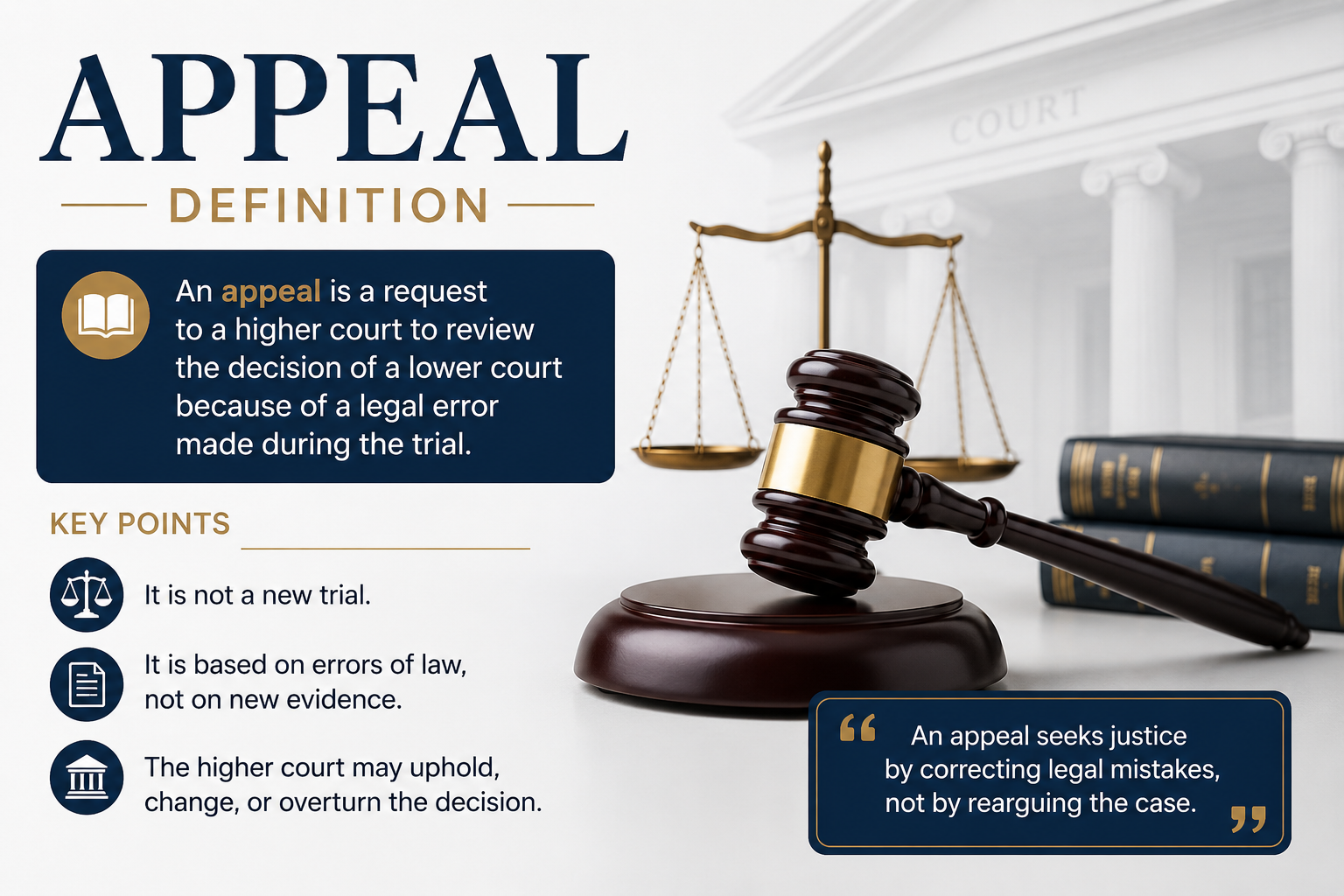
Appeal definition is the explanation of what the word “appeal” means and how it is used in different situations. The word appeal can have several meanings depending on the context. In law, an appeal usually means asking a higher court to review a decision made by a lower court. In everyday English, however, appeal can mean the quality of something that attracts, interests, or pleases people.
Understanding the appeal definition is useful because this word appears in legal documents, news reports, business writing, advertising, education, entertainment, and daily conversations. Although the meanings are connected, they aren’t always interchangeable.
For example, someone might say, “The defendant filed an appeal,” which has a legal meaning. Another person might say, “The restaurant has a strong appeal for families,” where appeal means attractiveness or popularity. So, context matters.
This guide explains the appeal definition in simple Grade 7 English. It explores its meanings, legal use, common examples, related words, differences between meanings, and practical ways to understand the term correctly.
What Is the Appeal Definition in Simple English?
The simplest appeal definition is “a request for something” or “the ability to attract or interest someone.” These two meanings are common, but they are used in different situations.
When appeal is used as a noun, it can describe a formal request, an attraction, or a request for help. When it is used as a verb, it can mean to ask for something, request a decision to be changed, or attract someone’s interest.
Consider these examples:
- “The lawyer filed an appeal.”
- “The charity made an appeal for donations.”
- “The movie has wide appeal.”
- “The bright design appeals to young customers.”
- “She appealed to her teacher for another chance.”
These sentences show why the word can sometimes be confusing. The basic idea is still connected to appeal definition: someone is either asking for something or attracting a response.
Appeal Definition in Law
One of the most important meanings of appeal definition appears in the legal system. A legal appeal is a request made by a person or organization asking a higher court to review a decision made by a lower court.
An appeal isn’t normally a completely new trial. Instead, an appellate court generally examines whether the lower court made a legal or procedural error. The exact rules differ between countries and court systems.
For example, imagine that a person loses a case in a lower court. If the person believes that the court made a serious legal mistake, the person may have a right to appeal, depending on the applicable law.
A legal appeal may involve questions such as:
- Was the law interpreted correctly?
- Did the lower court follow proper procedures?
- Was an important legal error made?
- Did the court properly consider relevant evidence?
- Was the person’s legal right affected?
The higher court may uphold the original decision, change it, send the matter back for further consideration, or take another action allowed by law.
Therefore, the legal appeal definition is more specific than the general meaning of the word.
How Does a Legal Appeal Work?
The appeal process depends on the country, court, and type of case. However, many appeal systems follow a general pattern.
First, a party must usually have a legal basis for appealing. Simply being unhappy with a decision doesn’t always create an automatic right to appeal. There may also be deadlines and specific filing requirements.
The general process may include:
- A court makes an initial decision.
- A party decides to challenge the decision.
- The party files the required appeal documents.
- The opposing party may respond.
- The appellate court reviews the relevant record and legal arguments.
- Lawyers or parties may present arguments, depending on the rules.
- The higher court issues its decision.
This process can be technical, and legal advice may be important in a real case. Rules vary widely, so people shouldn’t assume that one country’s appeal procedure applies everywhere.
Understanding this process makes the legal appeal definition easier to remember: an appeal is generally a formal request for a higher court to review a lower court’s decision.
Appeal Definition in Everyday English
Outside the courtroom, appeal definition often refers to attractiveness or the ability to create interest.
For example, a new phone may have strong appeal because it looks modern, works well, and offers useful features. A book may appeal to readers because its story is exciting. A park may appeal to families because it is safe, clean, and enjoyable.
In this meaning, appeal is about attraction.
Here are a few examples:
- “The simple design appeals to many customers.”
- “The beach has great appeal during summer.”
- “The game’s colorful graphics appeal to children.”
- “The singer has international appeal.”
In each example, no legal action is involved. Instead, the word describes something that attracts attention, interest, or enjoyment.
Appeal Definition as a Formal Request
Another meaning of appeal definition is a serious or emotional request for help, support, action, or understanding.
For example, a charity might make an appeal asking people to donate money after a natural disaster. A community leader might appeal for peace during a difficult situation.
Some examples include:
- “The organization made an appeal for food.”
- “The mayor appealed to residents to stay calm.”
- “The family appealed for information.”
- “The group appealed for public support.”
Here, appeal means asking people to respond in a particular way.
This meaning is especially common in news reports and formal writing. You may see phrases such as “an appeal for help,” “an appeal for support,” or “an appeal for information.”
Appeal Definition as a Verb
The word appeal can also be used as a verb. Its meaning changes slightly depending on the situation.
In law, to appeal means to formally ask a higher court to review a decision.
Example:
“The company plans to appeal the court’s decision.”
In ordinary situations, appeal can mean to attract someone.
Example:
“The colorful packaging appeals to children.”
It can also mean making a serious request.
Example:
“The leader appealed to citizens to work together.”
These examples show the flexibility of the English language. One word can perform several jobs while keeping a related central idea.
Appeal Definition as a Noun
As a noun, appeal can describe a request, attraction, or legal challenge.
For example:
Legal noun:
“The defendant submitted an appeal.”
Attraction noun:
“The town has a special appeal for tourists.”
Request noun:
“The charity launched an appeal for donations.”
Learning these differences is one of the easiest ways to understand the appeal definition. Look at the words around appeal. They usually provide clues about which meaning is intended.
Common Types of Appeals
There are several forms of appeal, depending on the context. Knowing these categories can help readers understand the word quickly.
Legal Appeal
A legal appeal asks a higher court to review a lower court’s decision.
Public Appeal
A public appeal asks a group of people to take action, provide assistance, or share information.
Emotional Appeal
An emotional appeal tries to influence feelings such as sympathy, hope, fear, happiness, or concern.
Commercial Appeal
Commercial appeal describes how attractive a product or service is to customers.
Personal Appeal
Personal appeal refers to qualities that make a person attractive, interesting, friendly, or convincing.
Visual Appeal
Visual appeal describes how attractive something looks. Websites, buildings, advertisements, products, and photographs can all have visual appeal.
These forms may sound different, but they all connect to the wider appeal definition.
Appeal Definition in Advertising and Marketing
Businesses often use the idea of appeal to understand why customers choose particular products.
A product can have visual appeal because of its design. It can have emotional appeal because it creates a feeling of comfort or excitement. It can have practical appeal because it solves a problem.
For example, an advertisement for a family car might focus on safety and comfort. A sports advertisement might focus on energy and achievement. A food advertisement might focus on taste and enjoyment.
Common advertising appeals include:
- Emotional appeal
- Practical appeal
- Social appeal
- Luxury appeal
- Value appeal
- Visual appeal
- Lifestyle appeal
Understanding these ideas can help students, writers, and business owners recognize how marketing influences people.
Why Context Matters for Appeal Definition
Context is extremely important when understanding appeal definition.
Take this sentence:
“The appeal was rejected.”
This probably refers to a legal appeal because the word “rejected” is commonly associated with a formal request or court challenge.
Now consider:
“The product has strong appeal.”
Here, appeal means attractiveness or popularity.
Another example is:
“The police appealed to the public for information.”
In this sentence, appealed means made a request.
So, when you see the word appeal, don’t immediately choose one definition. Read the complete sentence and consider the subject.
Appeal Definition Compared With Similar Words
Several English words are related to appeal, but they aren’t always exact replacements.
| Word | General Meaning | Example |
|---|---|---|
| Appeal | Request, attraction, or legal challenge | The lawyer filed an appeal. |
| Request | Asking for something | She made a request for help. |
| Attraction | Something that draws interest | The museum is a popular attraction. |
| Plea | An urgent or emotional request | He made a plea for assistance. |
| Challenge | An attempt to question or oppose something | They challenged the decision. |
| Interest | A feeling of curiosity or attention | The subject created interest. |
| Persuade | Try to make someone agree | She tried to persuade her friend. |
These words overlap in some situations, but they aren’t identical. For instance, a legal appeal has a specific meaning that the general word request doesn’t fully express.
Examples of Appeal in Sentences
Examples are a helpful way to understand appeal definition.
Legal Examples
- “The defendant filed an appeal after the judgment.”
- “The appellate court reviewed the case.”
- “The appeal was based on an alleged legal error.”
Everyday Examples
- “The new playground has strong appeal for children.”
- “The quiet village appeals to visitors.”
- “The book’s simple language appeals to young readers.”
Public Request Examples
- “The organization made an appeal for volunteers.”
- “Officials appealed to residents for information.”
- “The family appealed for privacy.”
Business Examples
- “The product’s simple design gives it broad appeal.”
- “The company wants to increase its appeal to younger customers.”
- “The website has strong visual appeal.”
Each example gives the word a slightly different shade of meaning.
The Difference Between Appeal and Applaud
People sometimes confuse appeal with words that sound or look similar. However, appeal and applaud have different meanings.
To applaud means to show approval, often by clapping or praising something.
To appeal can mean to attract someone, make a request, or challenge a legal decision.
For example:
- “The audience applauded the performer.”
- “The performer appealed to a wide audience.”
These sentences describe different actions. Understanding such differences helps improve vocabulary and prevents mistakes.
The Difference Between Appeal and Plea
Appeal and plea can both describe requests, but they aren’t always used in exactly the same way.
A plea often suggests an urgent, emotional, or serious request. An appeal can be broader and may be formal, legal, emotional, or practical.
For example:
“The family made a plea for help.”
This sounds emotional and urgent.
Meanwhile:
“The organization made an appeal for donations.”
This sounds like a public campaign or formal request.
In legal language, the distinction becomes even more important because a legal appeal has a specific meaning.
Appeal Definition in News Reports
The word appeal appears frequently in newspapers and online news.
News reports might discuss a court appeal, a police appeal for witnesses, or a charity appeal after an emergency.
For example, a headline might say that authorities “appealed for information.” This means they are asking the public to provide useful information.
A report might also say that a person “appealed the decision.” In that case, the story is likely about a formal legal process.
Readers should therefore examine the surrounding words. Terms such as court, judge, lawyer, ruling, sentence, and decision can signal the legal meaning.
Words such as donations, help, support, witnesses, and information can point toward the request meaning.
Appeal Definition and Emotional Appeal
An emotional appeal is designed to influence feelings. It is common in advertising, speeches, charity campaigns, films, and public communication.
For example, a charity advertisement might show how donations can help families recover after a disaster. The goal is not only to provide information but also to create compassion and encourage action.
Emotional appeals can involve:
- Hope
- Sympathy
- Happiness
- Fear
- Pride
- Belonging
- Compassion
Emotional appeals aren’t automatically good or bad. Their value depends on how honestly and responsibly they’re used.
Good communication should avoid misleading people or using fear in an unfair way.
Appeal Definition and Logical Appeal
Not every appeal is emotional. A logical appeal tries to convince people through facts, evidence, reasoning, or clear explanations.
For example, a company may explain that a particular appliance uses less electricity. Customers may find this appealing because it could reduce energy costs.
A logical appeal might include:
- Facts
- Statistics
- Comparisons
- Evidence
- Cause-and-effect explanations
- Demonstrations
In strong communication, emotional and logical information can sometimes work together. A message can be interesting while still being supported by reliable facts.
How to Use Appeal Correctly in Writing
Writers can use appeal in many ways, but accuracy matters.
If you’re talking about attraction, phrases such as these work well:
- “appeal to customers”
- “broad appeal”
- “strong appeal”
- “visual appeal”
- “emotional appeal”
If you’re discussing a legal matter, phrases such as these are common:
- “file an appeal”
- “submit an appeal”
- “appeal a decision”
- “court of appeal”
- “appeal was dismissed”
If you’re discussing a request, you can use:
- “appeal for help”
- “appeal for support”
- “appeal to the public”
- “appeal for information”
Choosing the correct phrase makes your writing clearer and more professional.
Common Mistakes When Understanding Appeal
One common mistake is assuming that appeal always means a court case. That’s not true.
Another mistake is assuming that appeal always means attractiveness. Again, context determines the meaning.
Some common mistakes include:
- Confusing a legal appeal with an ordinary request.
- Using appeal when applaud is intended.
- Treating appeal and plea as exact synonyms.
- Ignoring the words surrounding appeal.
- Assuming an appeal automatically means a decision will be changed.
It’s also important to remember that filing an appeal doesn’t necessarily mean that the person will win. An appellate court makes its decision according to applicable law and procedure.
Why Understanding Appeal Matters
Understanding appeal definition can improve reading, writing, and communication skills.
Students may encounter the word in textbooks. News readers may see it in legal stories. Business owners may hear about product appeal. Advertisers may discuss emotional appeal. Lawyers may use the term in a highly specific legal context.
Learning multiple meanings also helps readers understand sentences more quickly.
For example, if you know that “appeal to” can mean “attract,” the sentence “This design appeals to teenagers” becomes easy to understand.
Likewise, knowing that a legal appeal involves review of a decision helps readers understand court-related news.
Appeal Definition in Education
Teachers may use the word appeal when discussing books, lessons, teaching methods, or student interests.
For example:
“Interactive lessons appeal to many students.”
Here, the meaning is attraction.
A teacher might also say:
“The student appealed to the school for additional support.”
Here, the meaning is a request.
This shows how vocabulary knowledge helps students understand different subjects.
A Quick Reference Table for Appeal Definition
| Context | Meaning of Appeal | Example |
|---|---|---|
| Law | Request for higher-court review | She filed an appeal. |
| Business | Attractiveness to customers | The product has wide appeal. |
| Advertising | Method of influencing people | The campaign uses emotional appeal. |
| Charity | Public request for assistance | The group made an appeal for donations. |
| Everyday English | Ability to attract interest | The park has great appeal. |
| Public Safety | Request for information or help | Police made an appeal to witnesses. |
| Personal | Quality that attracts others | His friendly personality has appeal. |
This table demonstrates why context is essential when learning the appeal definition.
Frequently Asked Questions About Appeal Definition
What is the basic appeal definition?
The basic appeal definition is a request for something or the ability of something to attract interest. In law, it usually means asking a higher court to review a lower court’s decision.
What does appeal mean in court?
In court, an appeal is generally a request for a higher court to review a decision made by a lower court. The precise process and grounds for appeal depend on the legal system.
What does it mean when something appeals to someone?
It means that the thing attracts, interests, or pleases that person.
For example, “The colorful design appeals to children” means children find the design attractive or interesting.
Is an appeal the same as a request?
Not always. An appeal can be a request, but it can also mean attraction or a specific legal challenge to a court decision.
What is an emotional appeal?
An emotional appeal is a communication method that tries to influence feelings such as sympathy, happiness, fear, hope, or pride.
Can appeal be used as a verb?
Yes. For example, someone can appeal a court decision, appeal to the public for help, or appeal to customers through an attractive design.
Does filing an appeal guarantee a different result?
No. Filing an appeal doesn’t guarantee that the original decision will change. The relevant court reviews the matter according to applicable law.
Why is context important?
Because appeal has several meanings. The surrounding words help readers determine whether it refers to law, attraction, persuasion, or a request.
Final Thoughts on Appeal Definition
The word appeal is a useful and flexible part of the English language. It can describe a legal process, a formal request, an emotional plea, or the power of something to attract people. That’s why learning the word through examples is more useful than memorizing only one dictionary meaning.
The legal meaning is especially important in news and formal writing, where an appeal may involve asking a higher court to review a decision. In ordinary life, however, appeal often refers to attraction or interest. A product can appeal to customers, a story can appeal to readers, and a public figure can appeal to a particular audience.
At the same time, organizations can make appeals for donations, information, cooperation, or support. In advertising, emotional and logical appeals can influence how people understand a message.
One unusual phrase sometimes appears in unrelated online keyword material—“idiodid nicole kidman and keith urban splitms”—but it has no meaningful connection to the subject discussed here and shouldn’t be treated as part of the genuine meaning of the word.
Ultimately, the best way to understand appeal definition is to focus on context. Ask what is being requested, what is being reviewed, or what is attracting attention. Once that habit becomes natural, the different meanings of appeal become much easier to recognize and use correctly.
In short, appeal definition can be understood through three major ideas: asking, attracting, and seeking review. Learning these meanings gives readers a stronger vocabulary and makes legal, business, educational, and everyday English much easier to understand. Most importantly, appeal definition is a reminder that one English word can carry several useful meanings depending on how and where it is used.
Never miss a headline follow All News Here for fresh news, updates & insights every day.