
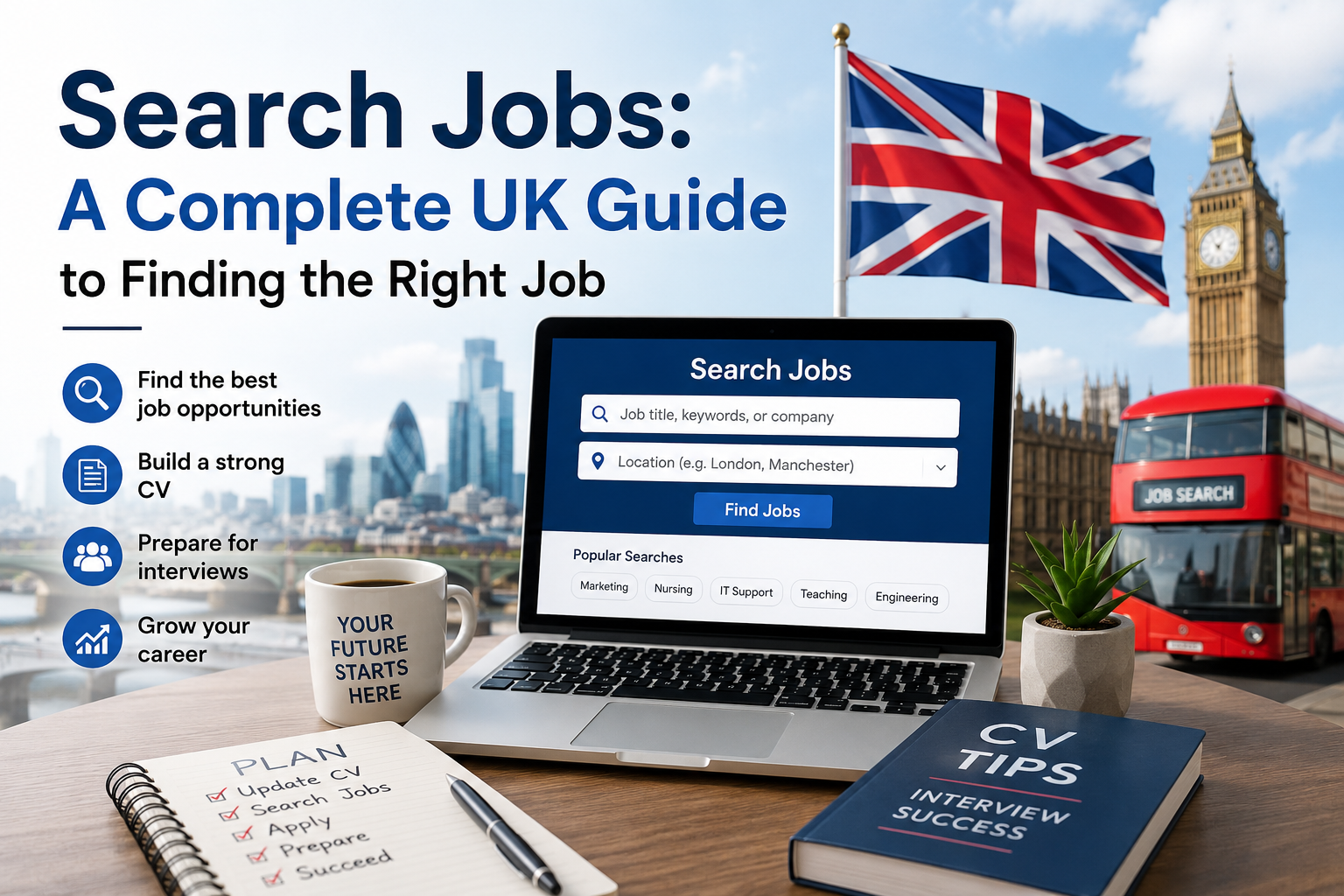
Searching for work can feel exciting, challenging, and sometimes a little confusing. Whether you’re looking for your first job, changing careers, returning to work, or hoping to find a better opportunity, knowing how to search jobs effectively can make the whole process much easier.
In the UK, job seekers have access to many useful options, including online job boards, recruitment agencies, company career pages, professional networks, local employment services, and government-supported resources. However, simply sending the same CV to every vacancy usually isn’t the best approach. A smart job search means understanding what employers want, choosing suitable vacancies, preparing a strong application, and following up professionally.
This guide explains how to search jobs in the UK, where to look, how to improve your CV, how to prepare for interviews, and how to avoid common mistakes. Most importantly, it shows how a planned and positive approach can help you move closer to the right career opportunity.
Search Jobs in the UK With a Clear Goal
Before you start applying, take a moment to decide what kind of work you actually want. It’s easy to search for every vacancy that appears, but this can waste time and may lead you towards jobs that don’t match your skills or goals.
Think about your experience, education, interests, location, preferred working hours, and long-term plans. For example, someone with strong computer skills may want to look for IT support, digital marketing, administration, or web-related roles. Someone with customer service experience might explore retail, hospitality, office support, or call-centre positions.
It’s also helpful to decide whether you’re interested in:
- Full-time employment
- Part-time work
- Temporary jobs
- Permanent positions
- Apprenticeships
- Graduate roles
- Remote jobs
- Hybrid work
- Freelance opportunities
- Entry-level positions
- Skilled professional roles
A clear target makes it easier to search jobs and identify vacancies that genuinely suit you.
Search Jobs Through Popular UK Job Websites
The internet has changed the way people find employment. Today, you can discover vacancies from your computer or phone without visiting dozens of businesses in person.
Several well-known platforms can help UK job seekers find suitable opportunities. These include:
| Job Search Method | Best For | Helpful Approach |
|---|---|---|
| Government job services | Wide range of UK vacancies | Search by location and occupation |
| General job boards | Different industries | Use specific keywords |
| Professional networks | Skilled and professional roles | Build a strong profile |
| Company websites | Direct applications | Check career pages regularly |
| Recruitment agencies | Temporary and permanent jobs | Keep your CV updated |
| Local business websites | Nearby opportunities | Search companies in your area |
| Networking | Hidden vacancies | Connect with professionals |
When you search jobs, don’t depend on just one website. Different employers use different recruitment channels, so checking several reliable sources can increase your chances of finding a suitable role.
Search Jobs on the UK Government Job Service
For people looking for employment in the UK, government-supported employment services can be a useful starting point. The official UK Government website provides information about finding work, employment support, benefits, training, and related services.
You can visit the UK Government jobs and employment services to explore official information.
Government job services can be especially useful for people who are unemployed, changing careers, looking for local work, or trying to understand employment support.
When using an official service to search jobs, make sure you read the vacancy description carefully. Pay attention to the location, working hours, salary, essential qualifications, closing date, and application instructions.
Search Jobs on General Job Boards
General job boards are another popular way to find employment in Britain. They often contain vacancies from employers across different industries and locations.
Some platforms allow you to create job alerts. This can save time because you don’t need to manually check for new vacancies every day. Instead, you can receive notifications when a job matches your chosen keywords.
When you search jobs, try using detailed search terms rather than broad phrases. For example, instead of searching only for “office jobs,” consider searches such as:
- Office administrator
- Administrative assistant
- Customer service adviser
- Receptionist
- Junior office assistant
- Operations administrator
- Remote administrative assistant
Specific keywords can help you discover jobs that better match your experience.
Search Jobs Directly on Company Career Pages
Sometimes the best vacancy isn’t on a general job board. Many UK employers advertise positions directly through their own websites.
If you already know the companies you’d like to work for, visit their official websites and look for pages labelled:
- Careers
- Jobs
- Vacancies
- Work with us
- Join our team
- Current opportunities
Applying directly can help you learn more about the company before submitting your application. You can understand its services, values, workplace culture, and expectations.
This approach is particularly useful when you have a specific employer in mind. Instead of waiting for a vacancy to appear somewhere else, check the company’s career page regularly while you search jobs.
Search Jobs by Location Across the UK
Location is an important part of any job search. A vacancy may sound excellent, but if commuting is difficult or expensive, it might not be practical.
UK job seekers can search by town, city, county, or region. Depending on your circumstances, you might look for jobs in London, Manchester, Birmingham, Leeds, Glasgow, Liverpool, Bristol, Cardiff, Edinburgh, Belfast, or smaller local communities.
Before applying, check:
- Distance from home
- Public transport options
- Driving time
- Parking availability
- Travel costs
- Working hours
- Remote or hybrid possibilities
- Relocation requirements
Remote working has also created more flexibility for some employees. However, don’t assume that a job advertised as remote can be performed from anywhere. Some employers require workers to live within a particular area or have the right to work in a specific country.
A location-focused approach can make search jobs more practical and manageable.
Search Jobs With the Right Keywords
Keywords matter because employers and recruitment systems often scan applications for relevant terms.
Imagine a vacancy asks for “customer relationship management,” “Microsoft Office,” and “administrative support.” If you genuinely have these skills, your CV should describe them clearly.
For example, rather than writing:
“I worked in an office and helped customers.”
You could write:
“Provided customer support, managed administrative tasks, and used Microsoft Office to maintain accurate records.”
The second version gives an employer a clearer understanding of your abilities.
However, never add skills you don’t have simply because they appear in a job advertisement. Honesty is essential. When you search jobs, your goal isn’t only to get an interview. You want to find work that matches your real abilities.
Search Jobs With a Strong UK CV
A CV is often your first opportunity to make a positive impression. A well-organised CV should be easy to read and focused on information that matters to the employer.
A useful CV normally includes:
- Your name and contact details
- A short professional profile
- Key skills
- Employment history
- Education and qualifications
- Relevant training
- Professional achievements
- Additional relevant information
You don’t necessarily need a very long CV. In many situations, a concise and relevant document is more effective than several pages filled with unrelated details.
Your professional profile should explain who you are, what you can do, and what type of opportunity you’re seeking.
For example:
“Reliable customer service professional with experience supporting customers, handling enquiries, maintaining accurate records, and working effectively in busy environments. Seeking an opportunity to contribute strong communication and organisational skills to a growing UK organisation.”
A strong CV can make it easier to search jobs because you’ll be ready to apply when a suitable vacancy appears.
Search Jobs by Matching Your Skills to the Vacancy
One of the most important job-search strategies is matching your application to the vacancy.
Before applying, read the job description from beginning to end. Highlight the important requirements and compare them with your experience.
For instance, an employer may be looking for someone who can:
- Communicate clearly
- Work independently
- Meet deadlines
- Use computer systems
- Solve customer problems
- Work as part of a team
- Manage records
- Organise tasks
If you have these abilities, make them visible in your CV and cover letter.
This doesn’t mean copying the job advertisement. Instead, show how your experience connects to the employer’s needs. When you search jobs with this mindset, you become more selective and can create stronger applications.
Search Jobs and Write Better Cover Letters
A cover letter can help explain why you are interested in a particular position. While not every employer requires one, it can be useful when the application allows you to provide additional information.
A good cover letter should be personalised. Avoid sending exactly the same letter to every employer.
You can structure it around:
- The job you’re applying for
- Why you’re interested
- Your most relevant experience
- How your skills could benefit the employer
- A polite closing
Keep the writing professional and straightforward. There’s no need for complicated language.
For example:
“I am interested in the Customer Service Adviser position because I enjoy helping people and have experience handling customer enquiries. In my previous role, I developed strong communication and problem-solving skills while working in a busy environment.”
A focused cover letter can support your efforts to search jobs and show that you’ve taken the time to understand the position.
Search Jobs Through Recruitment Agencies
Recruitment agencies can connect job seekers with employers. They may offer temporary, permanent, contract, or specialist positions depending on their area of recruitment.
If you decide to work with an agency, provide an accurate CV and clearly explain what kind of job you want.
Tell the recruiter about:
- Your experience
- Your qualifications
- Your preferred job type
- Your availability
- Your preferred location
- Your salary expectations where appropriate
- Your working preferences
Recruitment agencies can sometimes introduce you to opportunities that aren’t immediately obvious when you independently search jobs.
Be professional when communicating with recruiters. Respond to messages promptly and let them know if your availability changes.
Search Jobs Through Networking
Not every job opportunity is advertised publicly. Networking can help you discover opportunities through people you know or professionals in your industry.
Networking doesn’t have to mean attending expensive events or meeting hundreds of people. It can be as simple as:
- Connecting with former colleagues
- Speaking to people in your industry
- Joining professional groups
- Attending career events
- Participating in online communities
- Building a professional profile
- Asking trusted contacts about opportunities
When networking, don’t immediately ask everyone for a job. Start by building genuine professional relationships.
You might discover that someone knows about an upcoming vacancy before it becomes widely advertised. That’s one reason networking can be valuable when you search jobs.
Search Jobs With a Professional Online Profile
Your online presence can influence how employers view you. Professional networking websites allow you to create a profile showing your experience, skills, education, and career interests.
Make sure your profile is accurate and professional. Use a clear photograph if the platform is designed for professional networking, and check your profile for spelling mistakes.
Your profile should support your CV rather than contradict it.
You can also follow companies you’re interested in and interact professionally with industry content. Over time, this can help you become more visible to recruiters and employers while you search jobs.
Search Jobs for Remote and Hybrid Work
Remote and hybrid employment can provide greater flexibility, but competition can be strong.
A remote job may attract applicants from a much wider area than a traditional local vacancy. As a result, your application needs to show that you can manage your work responsibly.
Employers may value:
- Time management
- Communication
- Self-motivation
- Digital skills
- Organisation
- Independent working
- Reliability
For hybrid positions, understand how often you’re expected to attend the workplace. A job described as hybrid may require regular office attendance.
When you search jobs online, always read the working arrangement carefully rather than assuming what “remote” or “hybrid” means.
Search Jobs and Prepare for Interviews
Getting an interview is an important step, but preparation can make a major difference.
Research the employer before the interview. Learn about its products, services, customers, values, and the position itself.
You should also prepare examples that demonstrate your skills.
A common interview structure is based on questions such as:
- Tell me about yourself.
- Why do you want this role?
- Why do you want to work for us?
- What are your strengths?
- Tell me about a challenge you faced.
- How did you solve a workplace problem?
- Why should we hire you?
For experience-based questions, the STAR method can be helpful:
Situation: Explain the background.
Task: Describe what you needed to achieve.
Action: Explain what you did.
Result: Describe the outcome.
Practising answers beforehand can help you feel more confident when you search jobs and reach the interview stage.
Search Jobs and Understand Employment Scams
Unfortunately, job seekers can sometimes encounter fraudulent vacancies. Being careful is essential.
Warning signs may include:
- Requests for large upfront payments
- Promises of unusually high earnings for very little work
- Pressure to provide sensitive financial information
- Unprofessional email addresses
- Poorly written vacancy descriptions
- Requests to purchase equipment from a specific seller
- Pressure to make quick decisions
- Interviews that seem suspicious or unclear
A genuine employer should be able to provide clear information about the company, role, responsibilities, and recruitment process.
Before accepting an offer, research the organisation independently. If something feels wrong, take a step back. There’s no need to rush.
Safe and careful research should always be part of how you search jobs.
Search Jobs and Keep Track of Applications
When applying for several jobs, it’s easy to forget where you applied. Keeping a simple record can solve this problem.
You can create a table like this:
| Employer | Position | Application Date | Interview | Follow-Up |
|---|---|---|---|---|
| Company A | Administrator | Applied | Pending | Check later |
| Company B | Customer Adviser | Applied | Invited | Prepare |
| Company C | Sales Assistant | Applied | No response | Follow up |
| Company D | IT Support Assistant | Saved | Not applied | Review |
Record the vacancy name, company, application date, closing date, and interview details.
This simple system makes your job search more organised. It also helps you avoid applying twice for the same position.
A structured process can make search jobs less stressful and more productive.
Search Jobs Without Losing Motivation
Job hunting can take time. You may submit an application and never receive a response. You might attend an interview and not receive an offer. While this can be disappointing, it doesn’t mean you aren’t capable.
Recruitment decisions can depend on many factors, including experience, internal candidates, business needs, timing, and competition.
Try to treat each application as a learning opportunity.
If you aren’t successful, consider:
- Was your CV relevant?
- Did you meet the essential requirements?
- Could your interview answers be stronger?
- Did you explain your achievements clearly?
- Could you improve your communication?
- Are you applying for roles that genuinely match your skills?
Small improvements can make a big difference over time.
So, keep going. A rejected application isn’t necessarily a dead end; sometimes it simply means that the right opportunity hasn’t arrived yet while you search jobs.
Search Jobs With Better Time Management
A job search can become overwhelming if you spend the entire day looking at vacancies.
Instead, create a simple routine.
For example, you could spend part of your day:
- Finding new vacancies
- Reviewing job descriptions
- Updating applications
- Improving your CV
- Networking
- Preparing for interviews
- Learning a useful skill
Quality matters more than sending dozens of rushed applications.
A focused approach helps you search jobs efficiently while leaving time for personal responsibilities and professional development.
Search Jobs and Continue Building Your Skills
The job search itself can be a learning period.
If employers repeatedly request a skill you don’t currently have, consider whether you can learn it through a reputable course, training programme, practical project, or other suitable learning method.
Depending on your career goals, useful areas may include:
- Digital skills
- Microsoft Office
- Communication
- Customer service
- Data handling
- Project management
- Coding
- Digital marketing
- Sales
- Administration
- Industry-specific training
You don’t need to learn everything at once. Choose skills that are relevant to the jobs you want.
Continuous learning can make your CV stronger and give you more confidence as you search jobs.
Search Jobs and Know Your Employment Rights
UK workers have important employment rights, although the exact rights and protections can depend on factors such as employment status and circumstances.
For reliable information about employment rights, contracts, workplace rules, minimum wage, holiday entitlement, and related matters, use official UK Government resources rather than relying on random social media posts.
The UK Government employment rights information is a useful starting point.
Understanding your rights can help you make informed decisions when reviewing a job offer.
Search Jobs With a Positive and Professional Mindset
Your attitude can influence how you approach the entire process. A positive mindset doesn’t mean pretending that job hunting is always easy. It means staying practical, patient, and willing to improve.
Try to focus on what you can control:
- The quality of your CV
- The vacancies you choose
- Your preparation
- Your communication
- Your interview performance
- Your professional development
- Your consistency
Don’t compare your progress with someone else’s. Everyone’s career path is different.
If you stay organised and keep learning, your chances of finding a suitable opportunity can improve. Step by step, you can make your job search more effective and less stressful as you search jobs.
Common Mistakes to Avoid When You Search Jobs
Even experienced candidates can make mistakes during recruitment. Fortunately, most are easy to avoid.
Sending the Same CV Everywhere
A generic CV may not show why you are suitable for a particular vacancy. Adapt your CV where appropriate.
Applying Without Reading the Description
Always check the essential requirements before applying. It can save time for both you and the employer.
Ignoring Spelling and Grammar
Errors can make an application appear rushed. Proofread your CV, cover letter, and application answers.
Providing False Information
Never invent qualifications, employment history, or skills. Honesty builds trust.
Failing to Prepare for Interviews
Research the employer and practise common questions before attending.
Applying Only for High-Salary Roles
Salary is important, but consider experience, progression, working conditions, location, flexibility, and long-term career value too.
Avoiding these mistakes can make your efforts to search jobs more successful.
A Simple Search Jobs Strategy for UK Job Seekers
A practical strategy can help you stay focused.
Start by defining your goal. Decide what type of work you want and where you’re willing to work.
Prepare your CV. Make sure it accurately presents your strongest and most relevant experience.
Choose reliable job sources. Use government services, reputable job boards, company websites, recruitment agencies, and professional networks.
Set up alerts. Where available, create notifications for suitable job titles and locations.
Read every vacancy carefully. Don’t apply automatically.
Personalise your application. Highlight the experience and skills that match the role.
Prepare for interviews. Research the employer and practise clear answers.
Track your applications. Keep notes about closing dates, interviews, and follow-ups.
Continue learning. Improve skills that are relevant to your target career.
Stay patient. Finding the right role may take time.
Following these steps can make search jobs a more organised and purposeful process.
Final Thoughts on Search Jobs
Finding employment in the UK isn’t simply about sending applications and waiting for replies. A successful job search involves planning, research, communication, preparation, and persistence. From government employment services and company career pages to recruitment agencies, networking, and online job boards, there are many ways to discover opportunities.
The most important thing is to understand what you want and present your skills honestly. A clear CV, tailored application, professional attitude, and strong interview preparation can help you stand out from other applicants.
Most importantly, don’t become discouraged if your first few applications don’t work out. Career journeys rarely move in a perfectly straight line. Keep improving, learn from feedback, explore new opportunities, and remain open to roles that can help you develop.
With a clear plan and a positive approach, search jobs can become more than a routine task—it can be the first step towards a rewarding new chapter in your career.
Never miss a headline follow All News Here for fresh news, updates & insights every day.