
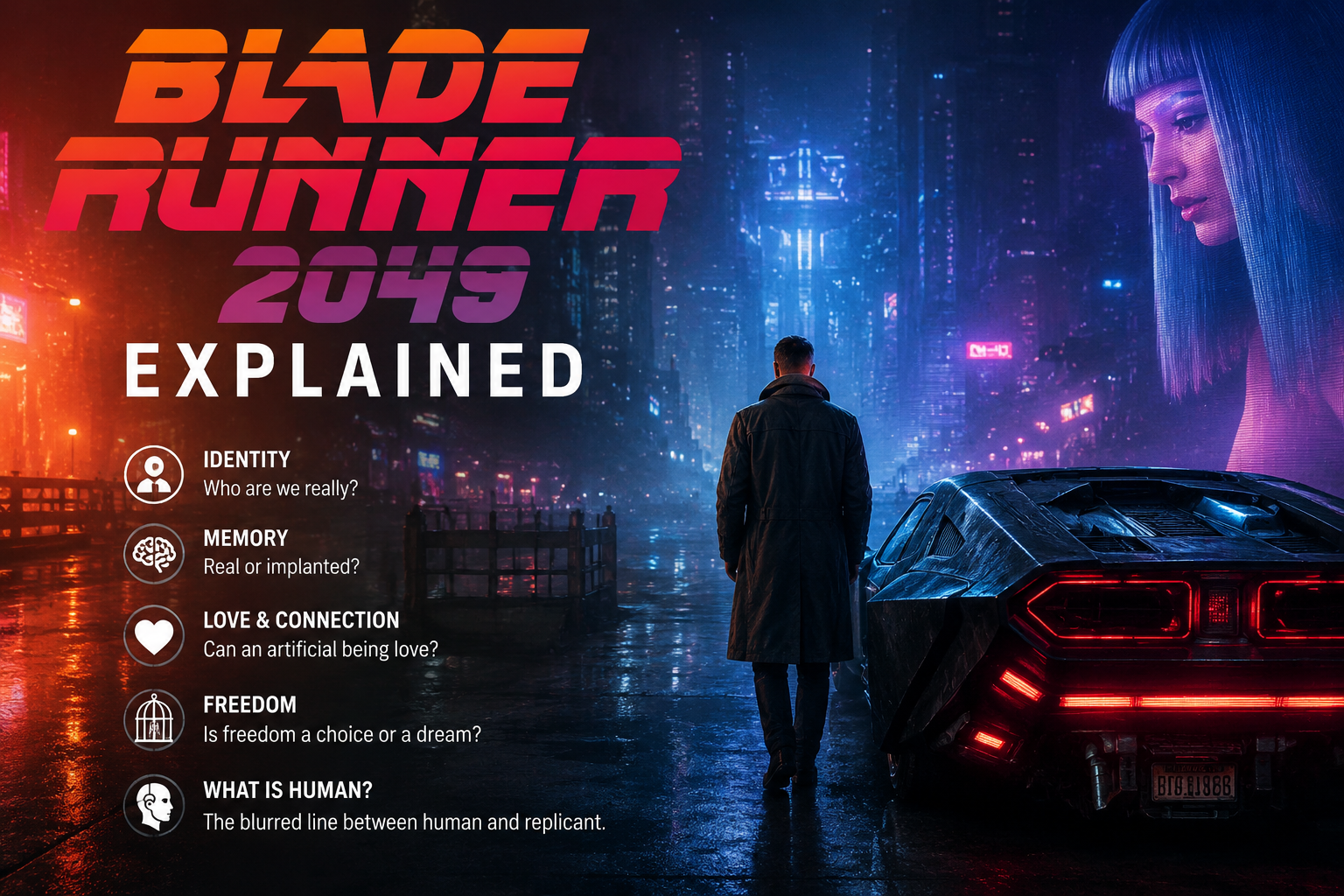
blade runner 2049 explained is a fascinating topic because Denis Villeneuve’s science-fiction film is much more than a story about robots, detectives, and a future city. Released in 2017, Blade Runner 2049 explores identity, memory, love, freedom, artificial life, and the meaning of being human.
At first, the movie can feel slow and confusing. There are mysterious clues, artificial memories, missing people, and characters who don’t always tell the truth. However, once the important pieces are connected, the story becomes much easier to understand.
The film takes place several decades after the events of the original Blade Runner. It follows K, a replicant blade runner working for the Los Angeles Police Department. His job is to find older replicants who have escaped and are living illegally.
K believes he understands his place in the world. He’s a manufactured person doing a manufactured job. But an unusual discovery changes everything. Suddenly, K starts questioning his memories, his identity, and whether he might be something more than an artificial creation.
This article provides a complete blade runner 2049 explained guide, including the story, major characters, replicants, Joi, Deckard, the child mystery, and the ending.
What Is Blade Runner 2049 About?
At its heart, Blade Runner 2049 is about a replicant named K who discovers evidence that could change the relationship between humans and replicants forever.
Replicants are artificial humans created through advanced technology. They look and behave like ordinary people, but they’re manufactured rather than naturally born.
K is one of these replicants. He works as a blade runner, which means he hunts down older replicants who have escaped from their assigned lives.
During one investigation, K finds something shocking on an abandoned farm. Buried beneath a tree are the remains of a female replicant.
The discovery becomes extremely important because the evidence suggests something that society believes should be impossible:
A replicant may have given birth to a child.
That possibility creates a dangerous mystery.
If replicants can naturally reproduce, they may no longer need humans to manufacture them. This could completely change the balance of power between humans and artificial people.
K is ordered to destroy evidence of the discovery. Instead, he begins investigating it.
As he follows the clues, he becomes personally connected to the mystery. He finds memories that seem to belong to him and starts wondering whether he could be the child everyone is searching for.
That’s where the story becomes deeply personal.
Blade Runner 2049 Explained Through Its Future World
The world of Blade Runner 2049 is dark, damaged, and highly technological.
Los Angeles has become even more crowded and polluted. Giant buildings, holographic advertisements, artificial intelligence, flying vehicles, and powerful corporations dominate daily life.
Humanity has also experienced major disasters.
One important event is the Blackout, which destroyed enormous amounts of digital information. Records disappeared, memories were lost, and many details about the past became impossible to verify.
This matters because memories play a major role in the film.
In this world, information isn’t simply history. Information can determine someone’s identity.
The movie also shows a society where replicants are treated as property or tools. Even though they can think, feel, and form relationships, they’re often considered less important than naturally born humans.
K is a good example.
He has emotions and personal desires, but his employers expect him to follow orders without questioning them.
This creates one of the film’s central questions:
If a being can think, love, suffer, dream, and make choices, does it really matter how that being was created?
Who Is K in Blade Runner 2049?
K is the main character of the movie, played by Ryan Gosling.
His official designation is KD6-3.7, although most people simply call him K.
He’s a Nexus-9 replicant working as a blade runner.
Unlike older replicants, Nexus-9 models are designed to be more obedient. They’re also considered more stable and reliable.
K’s life is deliberately controlled.
He works, follows orders, returns home, and spends time with his artificial companion Joi. He doesn’t expect to become a hero.
In fact, K initially believes he’s not particularly important.
That belief changes after he discovers the remains of the female replicant.
K eventually finds evidence that seems connected to a childhood memory. In that memory, a wooden horse is hidden in a particular location.
When K later finds that exact wooden horse, he becomes convinced that the memory isn’t simply a programmed fantasy.
For a while, K believes this proves that he’s the naturally born replicant child.
But the truth is more complicated.
The Replicant Birth Mystery
The central mystery begins when K discovers the bones of a replicant woman named Rachael.
Rachael is important because fans of the original Blade Runner will recognize her as a major character from that film.
The discovery reveals something extraordinary.
Rachael had a child.
This is shocking because replicants were believed to be incapable of natural reproduction.
The child was hidden to protect them.
K’s investigation eventually connects Rachael to Rick Deckard, the former blade runner from the original movie.
Deckard had disappeared after falling in love with Rachael.
The mystery now becomes a race.
Several groups want to find the child.
The Wallace Corporation wants the child because natural reproduction could make replicants far more valuable. If replicants could reproduce themselves, the corporation could potentially expand its workforce without depending entirely on manufacturing.
A secret replicant resistance also wants the child.
For the resistance, the child represents something much bigger than one individual.
The child’s existence proves that replicants aren’t simply manufactured products.
They can create life.
That possibility could inspire a revolution.
Who Is Rachael?
Rachael is one of the most important characters connecting the two movies.
In the original Blade Runner, Rachael is introduced as a sophisticated replicant who initially doesn’t know that she’s artificial.
She develops a relationship with Deckard.
In Blade Runner 2049, we learn that Rachael and Deckard had a child together.
Rachael eventually dies after giving birth.
Her death becomes one of the hidden tragedies behind the entire story.
The film doesn’t spend much time showing Rachael because her story happened years earlier. Instead, her presence is felt through the mystery surrounding her child.
Her existence also creates an important bridge between the original movie and the sequel.
Who Is Rick Deckard?
Rick Deckard, played by Harrison Ford, returns as one of the most important characters in Blade Runner 2049.
Deckard was the blade runner at the center of the original film.
By the time K finds him, Deckard has been living alone in an abandoned area.
He’s older, tired, and isolated.
Deckard’s relationship with Rachael is central to his past. He knows the truth about their child but has spent years keeping that information hidden.
His decision wasn’t simply selfish.
Deckard understood that the child would be in danger if powerful people discovered the truth.
When K finally meets him, Deckard initially refuses to cooperate.
Their relationship becomes tense, and the two characters eventually fight.
Yet their connection is more meaningful than it first appears.
K isn’t Deckard’s biological son, but K’s journey helps Deckard reconnect with the child he sacrificed so much to protect.
Who Is the Real Child?
Here’s one of the biggest twists in blade runner 2049 explained:
K isn’t the child of Rachael and Deckard.
For much of the movie, K believes he might be the special child.
His childhood memory seems to confirm it.
He remembers a wooden horse being hidden from other children. When he discovers the same object in the real world, he assumes the memory must be evidence of his own past.
However, K eventually learns that the memory is real—but it belongs to someone else.
The real child is Dr. Ana Stelline.
Ana is a highly talented memory designer who creates artificial memories for replicants.
She’s living in a protected environment because of her unusual immune system.
When K visits her, she recognizes his wooden horse memory.
That’s because it was actually her memory.
Ana experienced the event as a child.
She created the memory for herself, and it somehow became part of the memories implanted into replicants.
This revelation completely changes K’s understanding of himself.
Why K Believes He Is Special
K’s belief that he’s the child isn’t simply a plot trick.
It’s important to his character development.
K spends most of his life believing he’s ordinary.
He’s a replicant. He’s owned by a system. He’s expected to follow orders. Even his name is essentially a number.
Then he discovers evidence suggesting that he might have been born naturally.
For the first time, K believes he could be unique.
He starts thinking:
- Maybe I’m not just a replicant.
- Maybe I have a real childhood.
- Maybe I was born rather than manufactured.
- Maybe I’m the person everyone has been searching for.
- Maybe my life has a special purpose.
But the truth is painful.
He’s not the child.
Yet this is also where K becomes truly important.
He learns that being special isn’t about how he was created.
It’s about what he chooses to do.
That’s one of the most powerful ideas in the entire film.
Joi and Her Importance to K
Joi is an artificial intelligence companion who lives with K.
She isn’t a physical human being. She’s software that can interact with K through holographic technology.
At first, Joi appears to be simply another product in the futuristic world.
However, her relationship with K becomes emotional.
Joi tells K that he’s special and gives him the name “Joe.”
She encourages him and provides companionship in a lonely world.
But the movie deliberately leaves an important question unanswered:
Does Joi truly love K, or is she programmed to make him feel loved?
That’s part of the film’s larger discussion about artificial emotions.
K doesn’t know whether Joi’s feelings are genuine.
The same uncertainty applies to K himself.
If K’s emotions come from an artificial brain, are they less meaningful?
The movie doesn’t give an easy answer.
Instead, it asks viewers to think about whether the origin of a feeling matters more than the feeling itself.
What Happens to Joi?
Joi becomes an important part of K’s journey.
After K discovers that the childhood memory is real, he begins believing that he’s the special child.
Joi supports this belief.
Later, K’s life becomes increasingly dangerous.
Joi’s portable device allows her to move outside their apartment, but she remains vulnerable because she’s essentially software.
During one major confrontation, Joi’s system is destroyed.
K is devastated.
Later, he encounters a giant advertisement featuring a Joi model.
The advertisement calls him “Joe,” which makes him question whether the relationship he experienced was unique or simply part of Joi’s programmed personality.
This is deliberately uncomfortable.
Maybe Joi truly loved him.
Maybe she was designed to make customers feel loved.
Perhaps both possibilities can exist at the same time.
That’s the point.
Who Is Niander Wallace?
Niander Wallace is the powerful businessman behind the Wallace Corporation.
Played by Jared Leto, Wallace is one of the film’s major antagonistic forces.
Wallace believes replicants are essential to humanity’s future.
However, he doesn’t see them as equals.
He sees them as products and tools.
Wallace is obsessed with the possibility of replicants reproducing naturally.
If he can discover how Rachael gave birth, he could potentially control a new generation of replicants.
This would give his corporation enormous power.
Wallace’s character represents the dangers of treating life as a business resource.
He talks about creation and progress, but his goals are largely connected to control and profit.
Luv and Her Role in the Story
Luv is Wallace’s trusted replicant assistant.
She is intelligent, physically powerful, and extremely loyal to Wallace.
She’s also one of the most dangerous characters in the film.
Luv is tasked with finding the child.
Unlike K, she doesn’t have the freedom to question her purpose in the same way.
She follows Wallace’s commands and does whatever is necessary to complete her mission.
Yet Luv also displays strong emotions.
She cries during important moments and shows signs of fear, anger, pride, and sadness.
This creates another major question:
If a replicant can experience powerful emotions, why should society consider that replicant less human?
Luv’s story reinforces the film’s argument that the boundary between human and artificial life isn’t as simple as people believe.
The Replicant Resistance
Not every replicant accepts the system that controls them.
A hidden replicant resistance movement exists in the world of the movie.
The resistance wants freedom and equality.
They understand that Rachael’s child could become a symbol for their cause.
If replicants can reproduce, then humans lose one of their biggest arguments for controlling them.
Replicants would no longer be completely dependent on human manufacturing.
The resistance therefore sees Ana as extremely important.
K eventually encounters members of the resistance and learns that the child must remain protected.
This changes his mission.
Instead of simply solving a mystery, K realizes that someone’s life is at stake.
Blade Runner 2049 Explained: The Meaning of the Wooden Horse
The wooden horse is one of the most important objects in the movie.
K’s memory shows him hiding a wooden horse from other children.
He remembers a specific number connected to it.
When K discovers the real wooden horse at the same location, he becomes convinced that the memory belongs to him.
But the horse actually belonged to Ana.
This is a clever storytelling device because it represents the difference between having a memory and owning the experience behind it.
K’s memory isn’t his own life.
It’s a memory created by another person.
Yet it still changes him.
The wooden horse therefore represents:
- Identity
- Childhood
- Memory
- Hope
- Truth
- The desire to belong
- The difference between creation and experience
The object also proves that artificial memories can contain genuine emotional meaning.
Why Memories Matter So Much
Memory is one of the biggest themes in blade runner 2049 explained.
The movie repeatedly asks whether memories make someone who they are.
Humans use memories to understand their past.
Replicants also have memories, but many of those memories are artificially created.
That creates a fascinating problem.
If someone remembers something that never happened to them, does that memory still affect who they are?
For K, the answer is clearly yes.
His false childhood memory gives him hope.
It motivates him to investigate.
It helps him believe that his life has meaning.
Even after learning the truth, the memory still matters.
This suggests that identity isn’t only about biological history.
It’s also about the choices we make based on our experiences.
The Meaning of K’s Final Choice
Near the end of the movie, K has a chance to make a major decision.
He could simply walk away.
Instead, he chooses to help Deckard.
K fights Luv and manages to rescue Deckard.
Afterward, K brings Deckard to meet Ana.
This is extremely important.
K knows that Ana is Deckard’s daughter.
He also knows that she doesn’t know exactly who Deckard is.
K could have claimed the glory of finding the child.
He could have told others that he was the special person.
But he doesn’t.
Instead, he protects the truth.
He gives Deckard the opportunity to meet his daughter.
That decision proves something much more important than K being biologically special.
K chooses to do the right thing even when he gets nothing in return.
That choice gives his life meaning.
Blade Runner 2049 Explained: The Ending
The ending is quiet but deeply emotional.
K successfully helps Deckard reach Ana.
Deckard walks toward the building where his daughter is working.
Ana is separated from the outside world because of her medical condition.
She sees Deckard through the glass.
Deckard looks at her.
Neither needs a long speech.
The emotional weight comes from the fact that father and daughter are finally brought together after years of separation.
Meanwhile, K lies outside on the steps.
Snow begins falling.
He has completed his mission.
He has saved Deckard.
He has protected Ana.
But he has also accepted that he isn’t the naturally born child.
K’s journey therefore ends with sacrifice.
He isn’t remembered as a chosen hero.
He doesn’t receive fame.
He doesn’t become powerful.
He simply makes a meaningful choice.
And that’s precisely why his ending is so powerful.
Is Deckard a Replicant?
One of the biggest questions connected to both Blade Runner movies is whether Deckard is a replicant.
Blade Runner 2049 intentionally avoids giving a simple answer.
The movie includes clues that can support different interpretations.
However, director Denis Villeneuve has emphasized the importance of ambiguity surrounding Deckard’s identity.
The story doesn’t need a definitive answer.
In fact, uncertainty makes the character more interesting.
If Deckard is human, his relationship with Rachael shows that humans and replicants can form a genuine connection.
If Deckard is a replicant, then his relationship with Rachael becomes another example of artificial beings developing emotions and creating something unexpected.
Either way, the central message remains.
The film is less interested in asking “What species are you?” and more interested in asking “What do you choose to become?”
Major Themes in Blade Runner 2049
The film contains several major themes that explain why it has remained so widely discussed.
| Theme | Meaning in the Film |
|---|---|
| Identity | K struggles to understand who he really is |
| Memory | Memories shape identity even when they’re artificial |
| Humanity | Replicants display emotions and moral choices |
| Freedom | Replicants want control over their own lives |
| Love | K and Joi question whether artificial love can be genuine |
| Birth | Rachael’s child challenges the rules of replicant creation |
| Sacrifice | K gives up his own interests to help Deckard and Ana |
| Control | Corporations and governments try to control artificial life |
| Loneliness | Many characters live isolated lives despite advanced technology |
| Choice | The film suggests choices can matter more than origins |
Why Blade Runner 2049 Feels Slow
Some viewers find Blade Runner 2049 slow compared with typical science-fiction action movies.
That’s intentional.
The film spends a lot of time showing K walking through empty environments, driving through enormous landscapes, talking with Joi, investigating clues, and thinking about his identity.
The pacing gives viewers time to absorb the world.
Instead of constantly explaining everything through dialogue, the film often communicates through:
- Visual details
- Silence
- Facial expressions
- Architecture
- Lighting
- Music
- Memories
- Small objects
- Character behavior
So, if you’re watching it for the first time and thinking, “Why is this taking so long?”—that’s understandable.
The movie isn’t primarily designed as a fast action adventure.
It’s a philosophical science-fiction mystery.
What Makes the Movie Different From Typical Sci-Fi?
Many science-fiction movies focus heavily on technology.
Blade Runner 2049 does something different.
Technology is everywhere, but the film asks what technology does to people’s emotions and relationships.
Artificial intelligence can create companionship.
Replicants can perform dangerous jobs.
Corporations can manufacture people.
Memories can be designed.
Yet none of these technologies solve loneliness.
In fact, they sometimes make loneliness worse.
K lives in an advanced world, but he’s deeply isolated.
Joi is always available, yet her artificial nature makes their relationship uncertain.
The film suggests that technological progress doesn’t automatically create a better life.
People still need connection, freedom, and purpose.
Blade Runner 2049 Explained in Simple Terms
If the entire movie feels complicated, here’s the basic story in simple language:
K is a replicant blade runner.
He discovers the remains of Rachael, a replicant who gave birth.
That should be impossible.
K is ordered to destroy evidence of the child.
Instead, he investigates.
He finds a childhood memory involving a wooden horse.
He believes the memory proves he’s the child.
K eventually discovers that the memory belongs to Ana Stelline.
Ana is actually Rachael and Deckard’s child.
The truth changes K’s understanding of himself.
Meanwhile, Wallace wants to find Ana because her existence could help him discover how replicants reproduce.
The replicant resistance also wants to protect her.
K eventually chooses to protect Deckard and reunite him with Ana.
He doesn’t become special because of his birth.
He becomes special because of his choice.
That’s the emotional heart of blade runner 2049 explained.
What Is the Main Message of Blade Runner 2049?
The movie’s main message is that humanity isn’t necessarily defined by biology.
K is artificial.
His memories are partly artificial.
His life was designed by other people.
Yet he develops compassion, courage, love, and self-sacrifice.
His final actions show that a person’s value can come from their choices rather than their origins.
The film also suggests that people often search for a special destiny when meaning can actually be created through everyday decisions.
K wants to believe he’s the chosen one.
But he eventually learns that he isn’t.
Instead of giving up, he chooses to help someone else.
That’s arguably more meaningful than being born special.
Final Thoughts on Blade Runner 2049 Explained
blade runner 2049 explained becomes much easier to understand when you stop looking at the movie only as a mystery about a replicant child. Underneath its futuristic setting, the film is a thoughtful story about identity, memory, love, freedom, and personal choice.
K begins the movie believing that his life has already been decided for him. He’s a replicant, a blade runner, and a worker following orders.
Then he discovers the possibility that he might be unique.
For a while, he thinks his life has a special destiny.
Eventually, he learns that he isn’t the naturally born child.
But that discovery doesn’t make his life meaningless.
Quite the opposite.
K finally realizes that meaning isn’t something you’re necessarily born with. Sometimes, meaning comes from what you choose to do.
He chooses to protect Ana.
He chooses to help Deckard.
He chooses to sacrifice his own interests.
And although K doesn’t receive a heroic celebration, his final actions make him one of the most memorable characters in modern science fiction.
In the end, blade runner 2049 explained isn’t simply a story about whether replicants can become human. It’s a story that asks whether humanity might be something we demonstrate through compassion, courage, love, and choice.
Never miss a headline follow All News Here for fresh news, updates & insights every day.